Category: Vermont

  • Quietly Quebec: French Canadians in Vermont

    Quietly Quebec: French Canadians in Vermont

    I’ve been thinking lately about two seemingly unconnected conversations. The first was with a friend, an immigration lawyer, who said that since Canada passed Law C-3 her business has been overrun with Americans applying for Canadian citizenship (C-3 eliminates the “first-generation limit”). The second conversation was with another friend who is married to a rural-born Quebecer who grew up in a lively farm family. She was observing how his family events were centred around the kitchen, not the living-room or parlor. Meals were served on the kitchen table and after a big feast, like Easter, everyone would push back their chairs to the walls and then the afternoon would be filled with conversation. For me there was a resonance in what she was saying.

    In the 1950s, in the hills of central Vermont, I was told I was growing up in “Yankee” country. The word rolled easily off adult tongues, summoning a picture of stone walls, maple sugaring, town meetings, and old leathery New England families who had been there forever. I hadn’t been, but that’s incidental to this story. When I think back, when I really replay what went on in those school corridors, walk into those kitchen-shed entrances, and sit at the kitchen tables in my mind, what I see and hear feels far less purely “Yankee” and much more like a quiet, unacknowledged extension of rural Quebec.
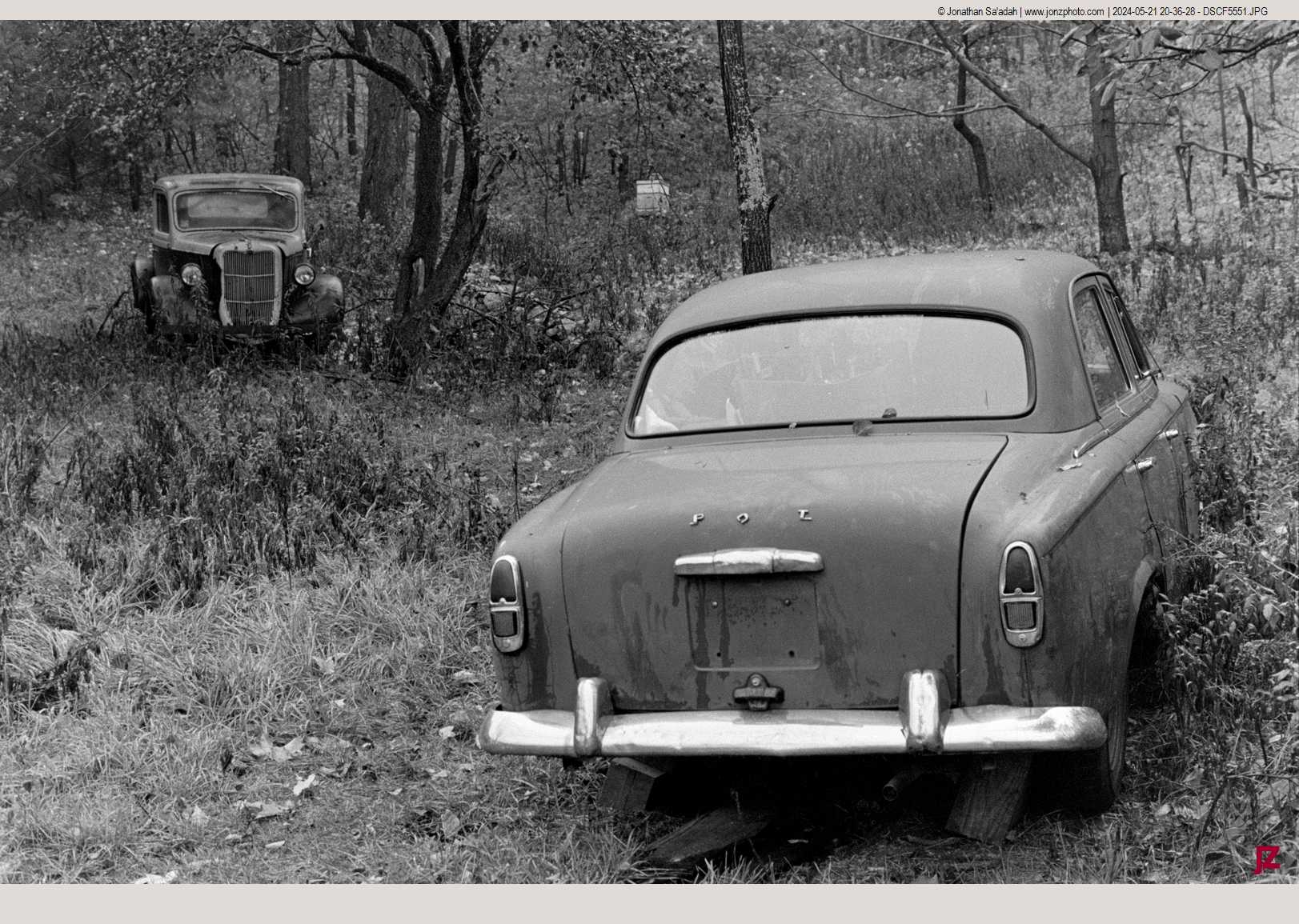
    An amusing (and unlikely) pair – a Peugot 504 (vintage 1950s) and a much earlier Ford truck – placeholders for French/Yankee duality – in the apple orchard of an old Vermont hill-farm (photo taken 1972).

    Many of my classmates were not Yankees at all. They were the children of Quebecers, families who had moved south over the border in search of work, trading rocky Quebec farm fields and the poor economy for Vermont’s mills and small factories. Their parents still spoke French at home, still had filet crocheted bible scenes on their walls, still crossed themselves instinctively, still held onto Catholic feast days and family rituals, even as their children sat beside me behind desks reciting the Pledge of Allegiance in English.
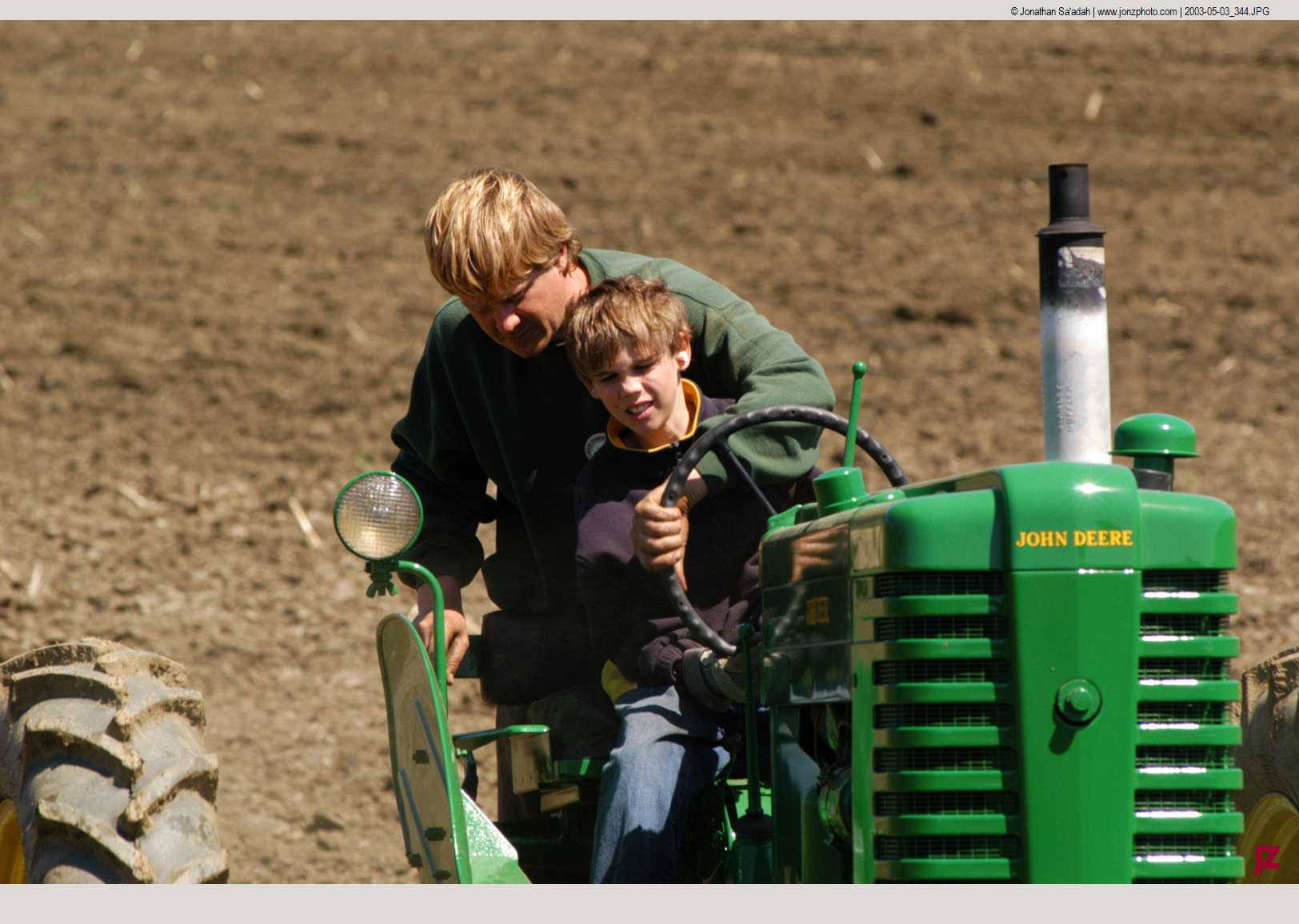
    The geography encouraged a kind of illusion. Compared with Quebec, with its broad St. Lawrence valley and wide fields, most of Vermont is hill country. The farms that still existed in those days were small and coughed up a lot of rocks, more a patchwork of cleared land between forests than the sweeping agricultural vistas one imagines when one says “farm.” Yet many of the people working those small farms, or supplying labor for the mills, had roots that ran straight back to Quebec. On paper, in town histories and news-stories, it might have been called “Yankee Vermont.” On the ground, it was something more complicated: a hybrid of old New England and transplanted rural Quebec, stitched together by rivers, roads, and the hum of machinery.
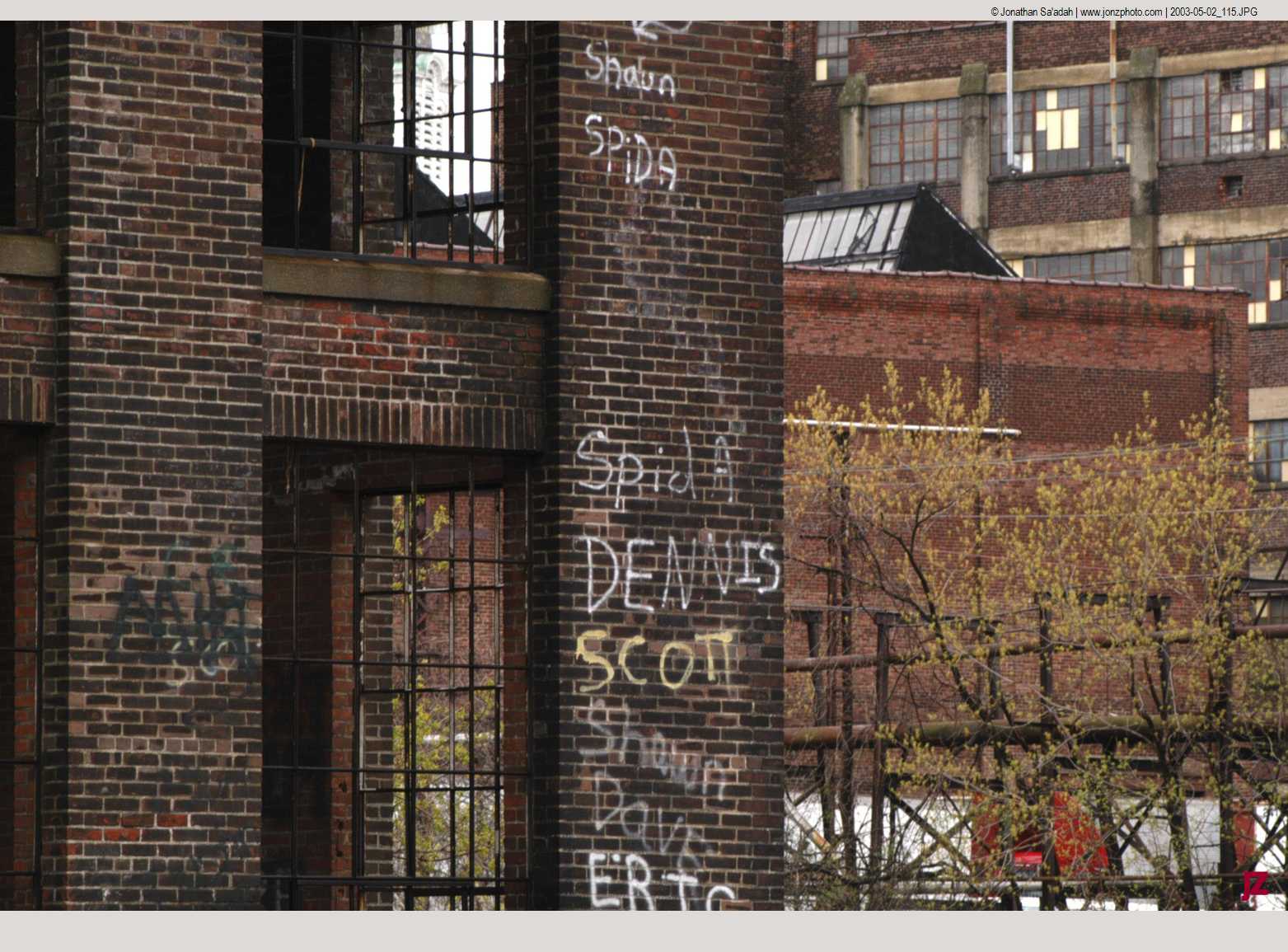
    The mills were the real magnets. They were scattered along Vermont’s rivers, some still visibly tied to the old water power era with raceways and old brick, others already retooled and electrified. In those years, they wove cotton and wool cloth, most of it rough, and a little further south (along the larger rivers) manufactured industrial parts. They were not glamorous places, but the work was steady, and they needed hands. Hands came from the hills and from across the border.

    So, in my grade school classroom, many of the desks were filled with kids whose grandparents had been farmers in Quebec, whose parents now worked for businesses in the town or the mills that bordered it. Many of them bore names that had been smoothed into English, as if the crossing of the border had required passing through a kind of linguistic customs warp. A “Leblanc” became “White.” Sometimes the change was deliberate. Other times, it seemed to have been imposed by immigration bureaucrats who simply wrote what they could pronounce. It was as if the name itself had to be pushed into shape to fit the idea of America. I knew the drill.
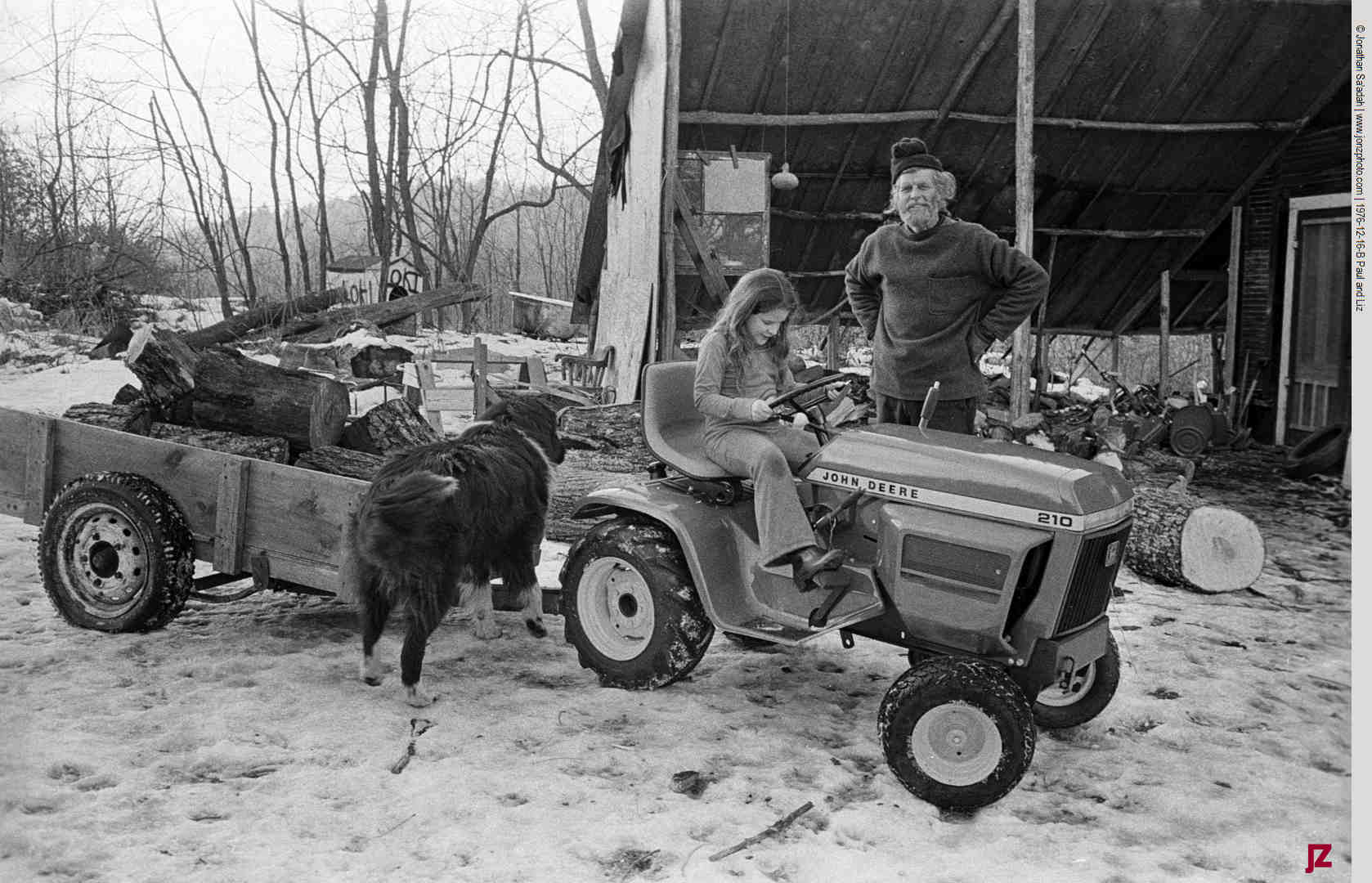
    Late spring and scrounging up the dregs of the woodpile.

    Some of my friends embraced that shaping. They practised their English carefully, and worked hard, as I did, to appear fully “American.” When you’re a child, you are acutely aware of the small signals that mark you as different, and you quickly learn to sand down those edges. When we were older we learned to call it racism. Others, though, held on to more of their ancestral life. They disappeared from play on certain feast days, learned their catechism, and later, in adolescence, you might see them slipping off to the large Catholic church that we never entered. Their houses felt different when you stepped inside: religious images on the walls, perhaps a rosary hanging from a nail, and often a sense that English was something you spoke for the outside world, not in the kitchen.

    Coming back to the kitchen and my friend’s description of her husband’s family gatherings. To me it always felt like the kitchen was the next room after the shed. First you went through the shed, a kind of transition area that had the sweet smell of split drying wood, moist earth, and wet wool. Then the was the warm kitchen, with a stove crackling and the smell of food being cooked.
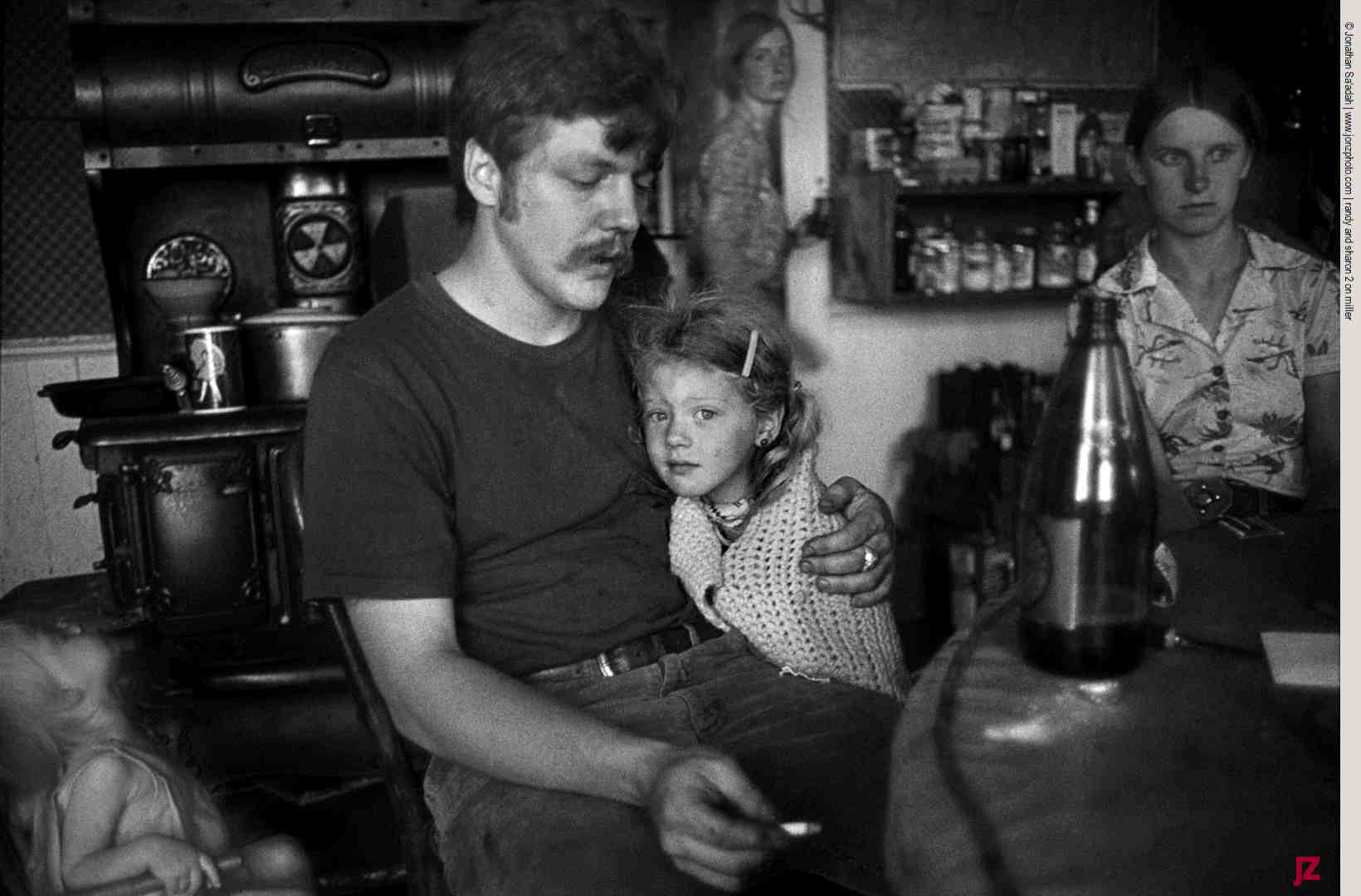
    But what really registered with me was pushing the chairs back, making a ring of people rather than a scattered group. I always liked being there. At the time, I understood those families as simply “farm families,” (though that wasn’t the way my parents described them). Only later did I understand how many of them were not just “country people,” but Quebecois by origin, bringing with them patterns of family life shaped north of the border.

    Of course, we did not have the language of “Franco-Americans” or “diaspora” for this; the word that floated around instead was “Frenchies,” often used with a derisive and mean edge. It was the sort of racist nickname that passed as normal in those days. The implication was that the “real” Vermonters, the real Americans (which I felt excluded from too), were the Yankees, and the “Frenchies” were a kind of tolerated, but alien, presence. Yet, in reality, Quebec immigrants made up a large portion of the local population – fifteen to twenty-five percent, by some estimates – and their influence seeped into the “Yankee” culture.

    As a child, I absorbed both the prejudice and the intimacy without fully understanding either. I heard the jokes and the slurs, but I also knew that the kid sitting next to me with a “funny name” (like mine!) was the one I skied with after school, or the one whose mother handed me a plate of food when I was a visitor. The contradiction was simply part of the air we breathed. We were caught between the received story – Vermont as a bastion of old Yankee stock – and the lived reality of a mixed, evolving community where Quebec was a silent but important part of the mix.
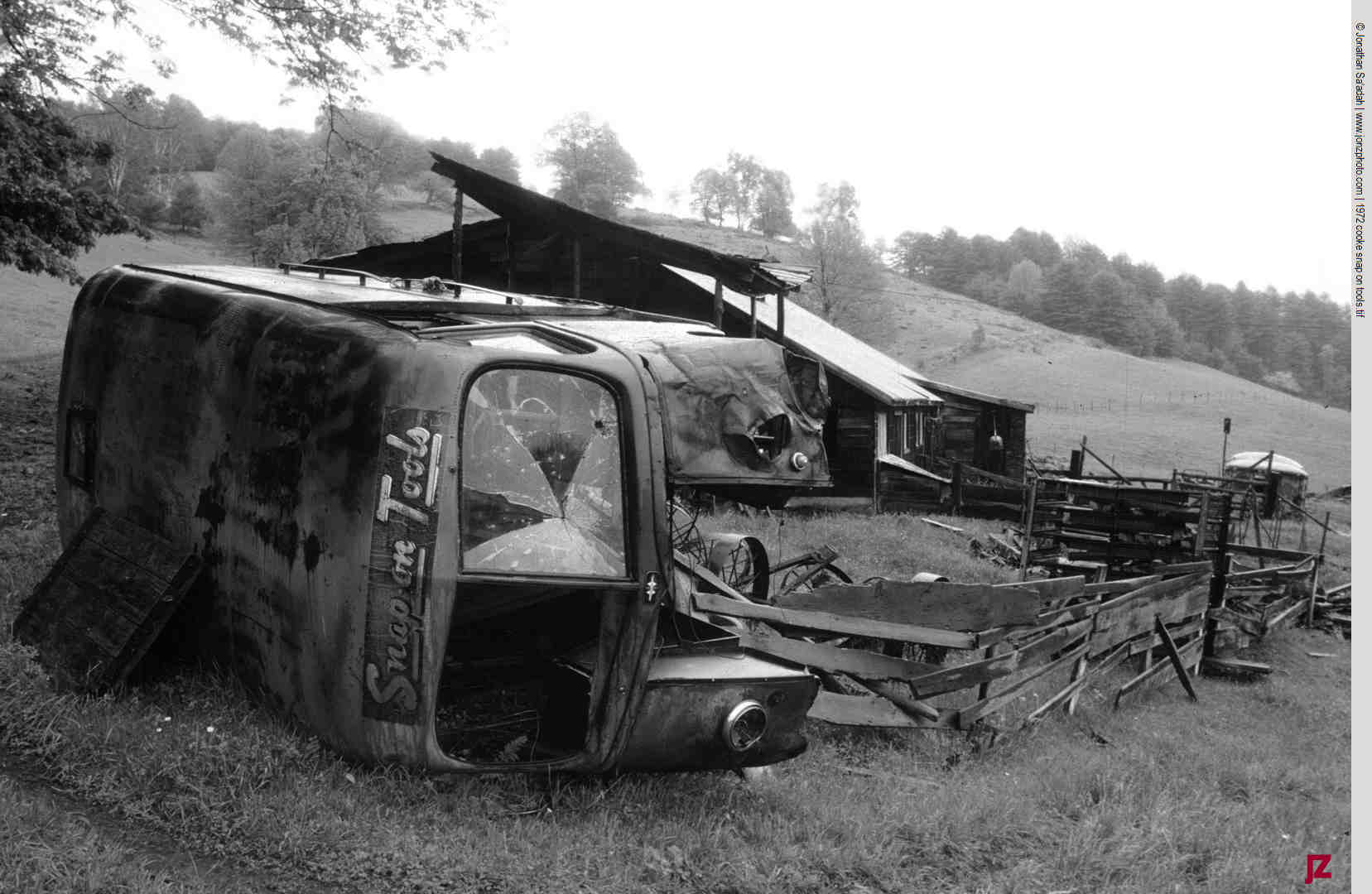
    Lately, hearing about law C‑3 and how it has opened the door for Americans with a Canadian parent or grandparent (or even further back) to claim Canadian citizenship, I find myself thinking about those classmates and their families. Many of them, I suspect, would now qualify to move back up here with little trouble. What strikes me is how, in the 1950s, the direction of movement was almost entirely one way: people came from Quebec to Vermont to work, to be American, to give their children a future “down south.” The border itself felt more like a one-way bridge than a shared threshold. Now, that’s changed.

    With C‑3, the current is running the other way. Americans are trying to reclaim or confirm a Canadian identity they only vaguely knew they had before, or even tried to conceal. Underneath the legal arguments – who qualifies, what documents are needed, how far back descent can run – I sense an echo from my childhood days. The law is new, but the story is old: families shifting across the invisible line that cuts through the hills and fields, children caught between languages and loyalties, names bending to fit whichever side of the border they find themselves on.

    For me I’m much more aware now that the most striking realization is not just that Vermont in the 1950s was more French Canadian than anyone wanted to admit, but that the ways people tried to appear “American” were often layered on top of habits and values that remained stubbornly, quietly Quebecois. The kitchen as the centre of family life. The chairs pushed back to make room for talk. The insistence on gathering everyone around a table, not just for the meal, but for the hours afterwards, when stories and teasing and small arguments stitched a family and friends together.

    In retrospect, that gesture of pushing back the chairs feels almost like a metaphor for the whole period. Publicly, the chairs of identity were lined up neatly: Yankee, American, English-speaking. Privately, inside the kitchens, they were rearranged, pushed back to the walls, making space for another way of being together – more communal, more rooted in the rhythms of Quebec than the official story would allow. I grew up in that in-between space, in some ways wanting to believe I was part of “Yankee Vermont” while actually feeling more comfortable sitting in kitchens surrounded by people whose lives had been shaped by the culture of where is my home now.

    Now, as Americans look north for citizenship rights and legal recognition, I find myself looking back instead – back to those kitchens and classrooms full of children with anglicized names and hidden bilingual homes. The border that seemed so definitive on maps was far more porous than we were taught. We didn’t then have the words or the awareness to describe it.
  • The Administrator’s Year: Running Vermont’s Most Radical CETA Arts Program

    The Administrator’s Year: Running Vermont’s Most Radical CETA Arts Program

    The history of American federal spending is littered with contradictions — moments when even unlikely leaders championed programs that would have lasting cultural impact. Such was the case with the Comprehensive Employment and Training Act (CETA), signed into law by President Richard Nixon in December 1973, not out of any particular regard for artists, but as part of a broader effort to combat unemployment during an economic downturn.

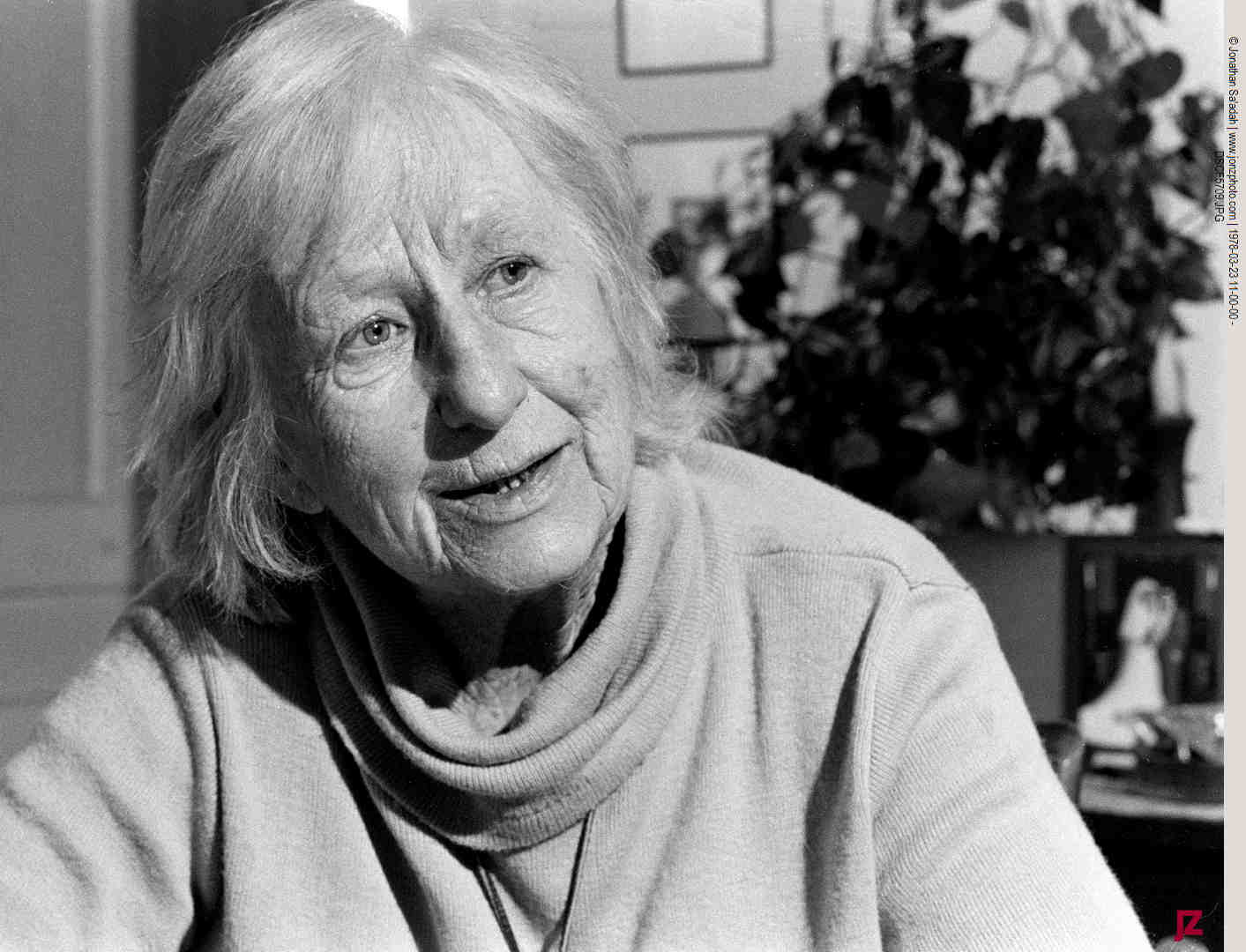
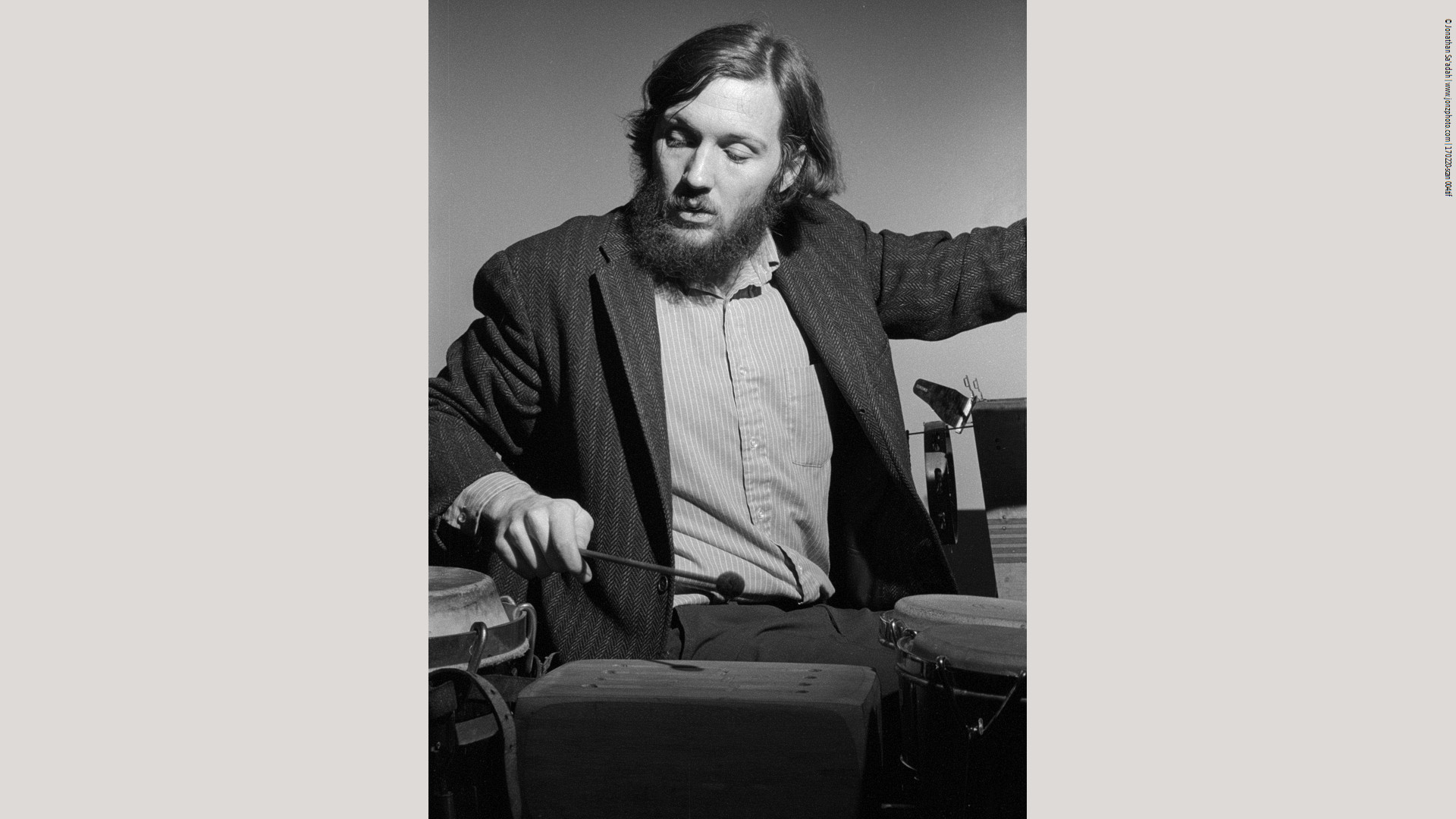
    Even in 1978 it was obvious that Ron Hadley was going to have a career as a jazz keyboard player. Almost 50 years later, he has, but the CETA job helped him at the early part of his career with some stability and a time to focus on his own compositions.

    Yet between 1974 and 1981, CETA would prove to be a transformative lifeline for the American arts community. More than 20,000 artists received full-time employment through the program — the largest federal support initiative for creative workers since the Depression-era Works Progress Administration. What distinguished CETA from its 1930s predecessor was its fundamentally decentralized structure: rather than operating as a centralized federal program, CETA distributed funds through more than 500 local entities, allowing individual communities to shape arts employment according to local needs and priorities.

    In Vermont, the state’s Arts Council became one such recipient, directing CETA funds towards organizations across the state for arts-related projects. At its peak, the program supported about 70 (exact number unknown) Vermont artists, paying them $10 per hour as teachers, radio stations producers, arts administrators/programmers embedded in community organizations, and ensemble performers — meaningful work that sustained a generation of creative workers in a state not known for deep pockets in the arts, and helped the organizations they were employed by. It also contributed to a rural ethos where Vermont drew radical artistic organizations and artists, such as the Bread and Puppet Theater, which moved to Glover and became a fixture in the state.

    How I Became an Arts Administrator

    In February 1977, I was hired to administer a program unique in Vermont and most likely in federal CETA history. The position came my way almost by accident. When Fonda Joy Segal, the renegade CETA administrator who had conceived and pushed through the program, began interviewing candidates, I lived nearby and was the first to walk through the door. Segal, a Brooklyn-born iconoclast who had met her husband while modeling at the School of Visual Arts in Manhattan and later moved to Vermont to open a health food store in Woodstock, saw something in me — or perhaps simply recognized that I was willing to take on the work.

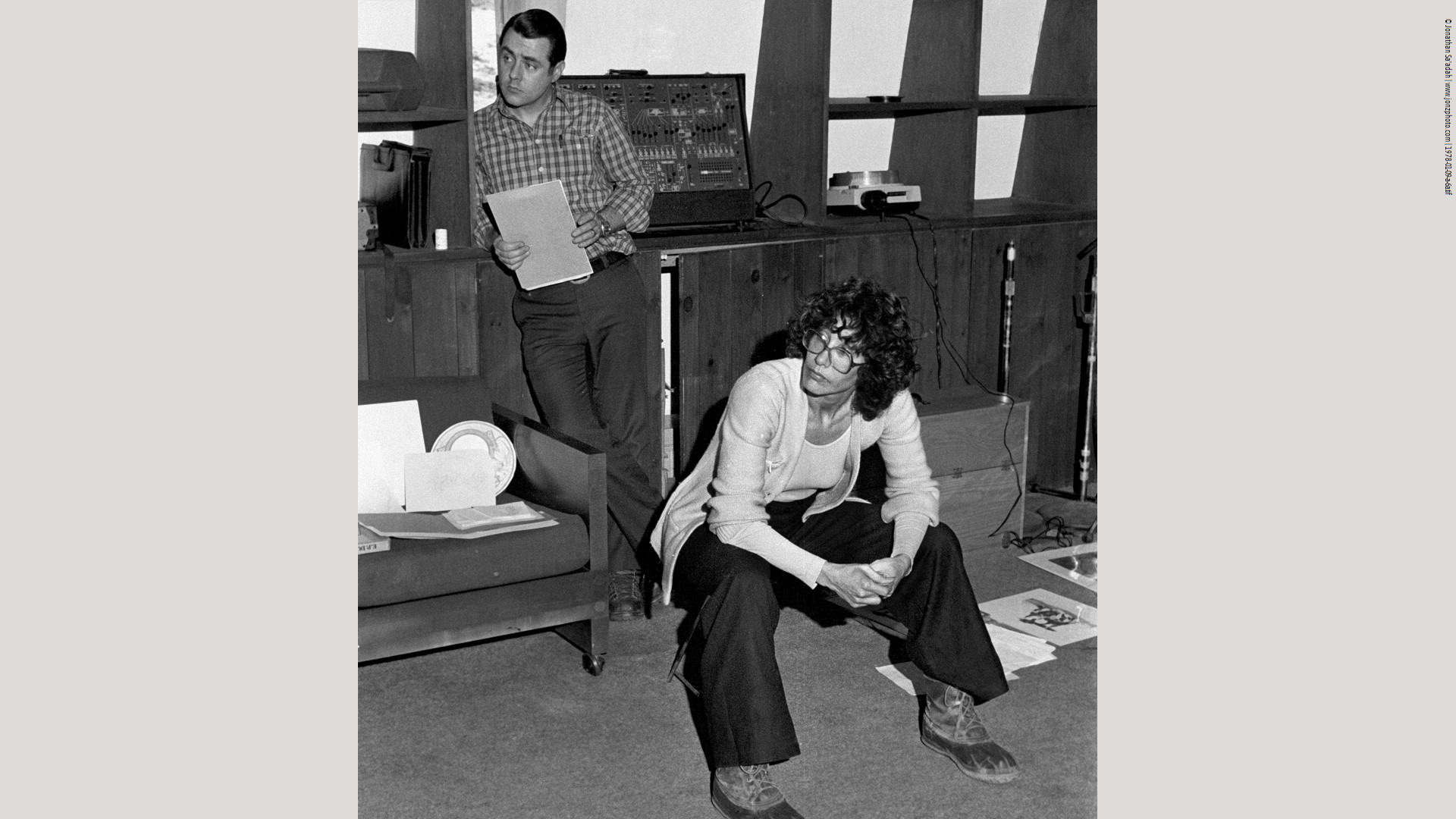
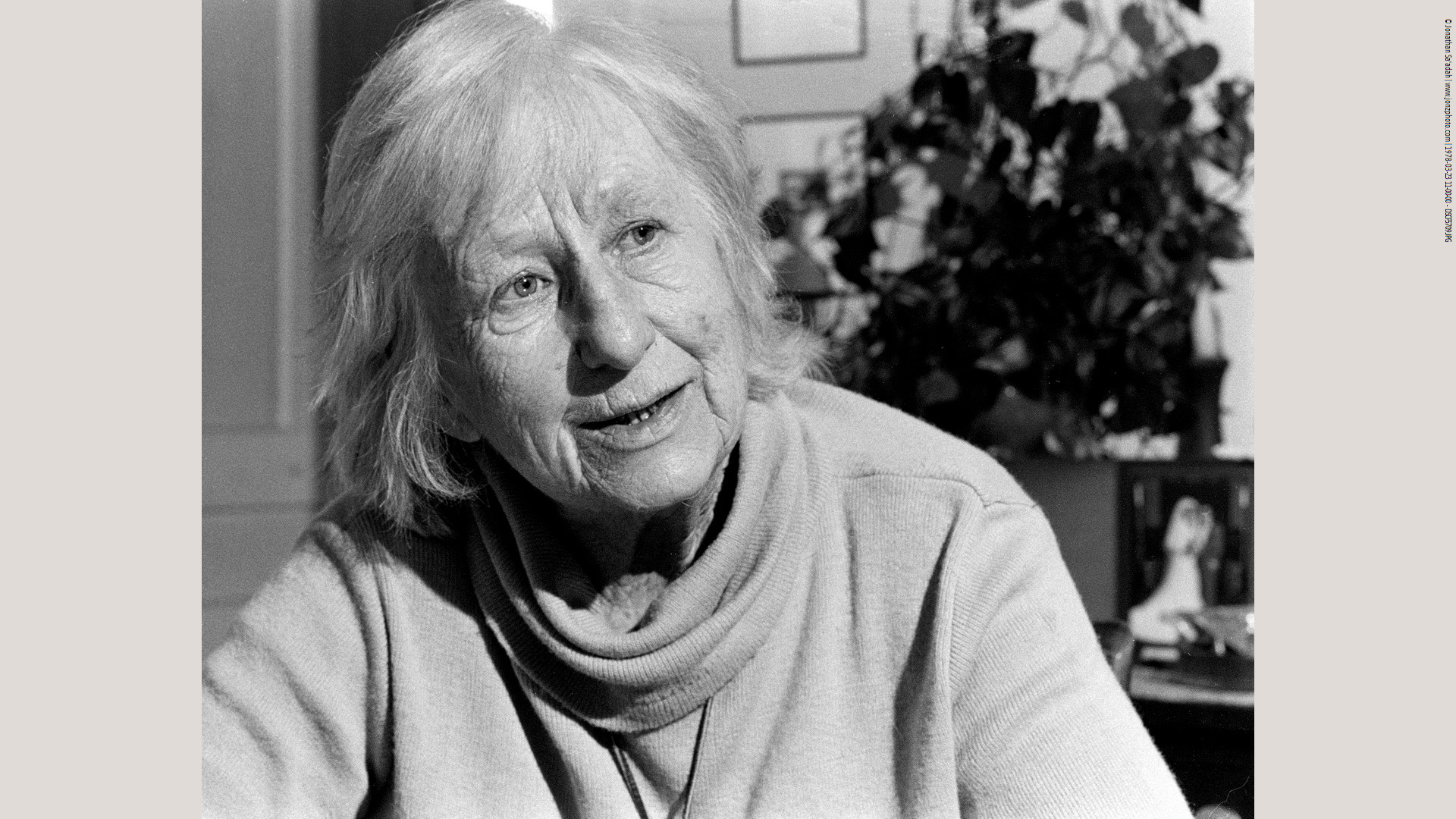
    Fonda Segal and Bill Schubert (owner of Philo Records) reviewing portfolios during the artist selection process. Ferrisburg, Vermont, January 1978.
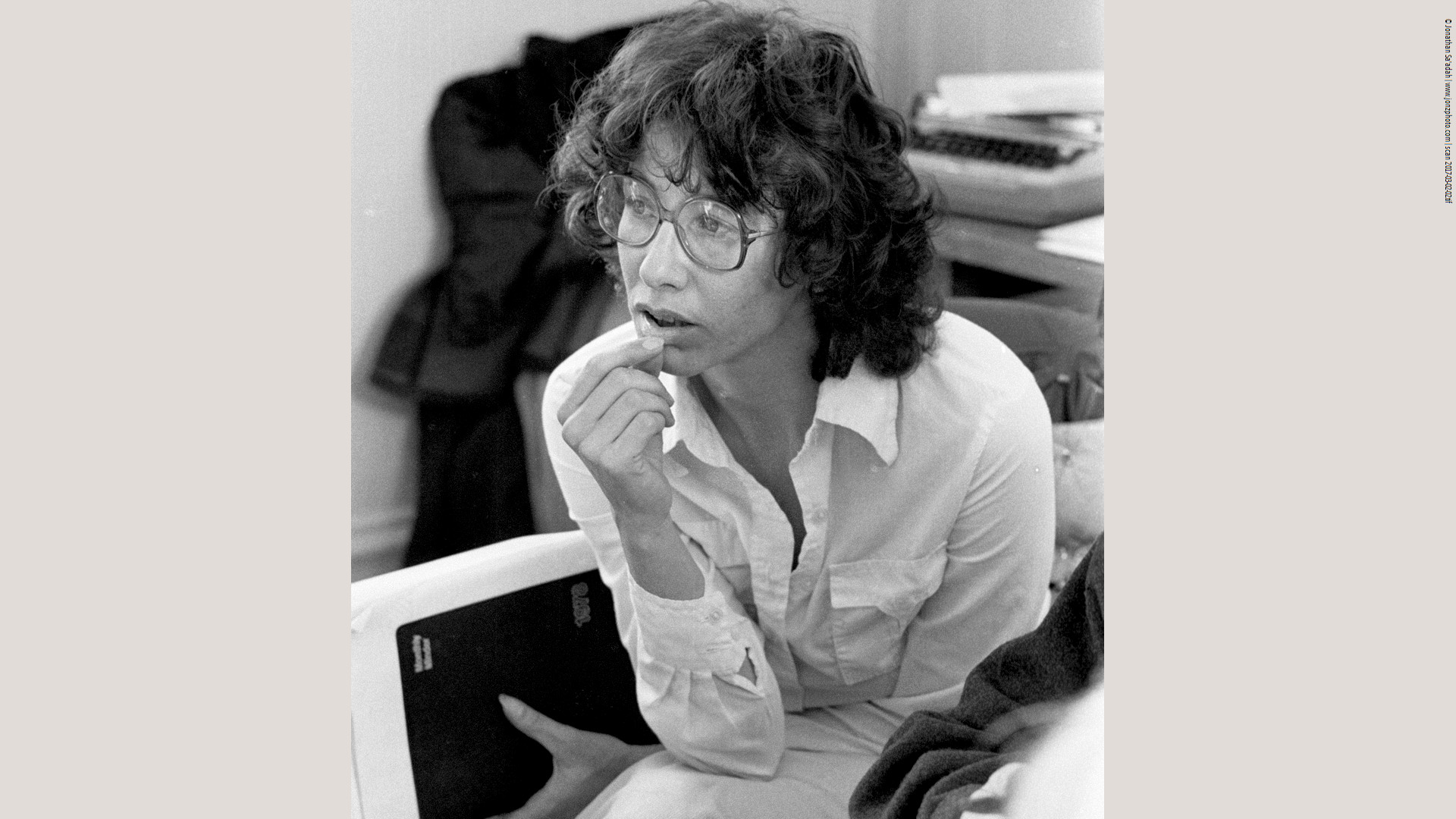
    Fonda in the program’s “administrative office”, shared with Pentangle Arts in Woodstock, Vermont.

    She offered me the job on the spot. I accepted, grateful for the steady income and intrigued with the prospect of traveling across Vermont to meet working artists. I had no way of knowing, in that moment, that this program would be one of the most experimental and short-lived arts programs launched by the arts “establishment” of the state.

    “Vermont Images” was Segal’s brainchild, and it represented a radical departure from how CETA funds were typically deployed. While other CETA programs paid artists to teach in schools or participate in cultural organizations, Vermont Images took a different approach entirely: it provided direct financial support to seven selected artists to pursue their own creative work, without any obligation to teach, exhibit, or serve institutional needs. It was unconditional support — a rarity in the bureaucratic world of government arts funding.

    My job was to make it work. As administrator, I was responsible for periodically meeting with each of the seven artists, monitoring the program’s progress, and coordinating the logistics of what was, in many ways, an act of faith in artistic practice itself.

    A Year Traversing the State

    Over the course of the program’s single year of operation, I traveled the length and breadth of the small state of Vermont. I crossed the Green Mountains. I drove through villages and rural hamlets. I found myself in the private creative spaces of serious working artists — people who had committed themselves to their practice despite the economic precarity that typically defines artistic life.

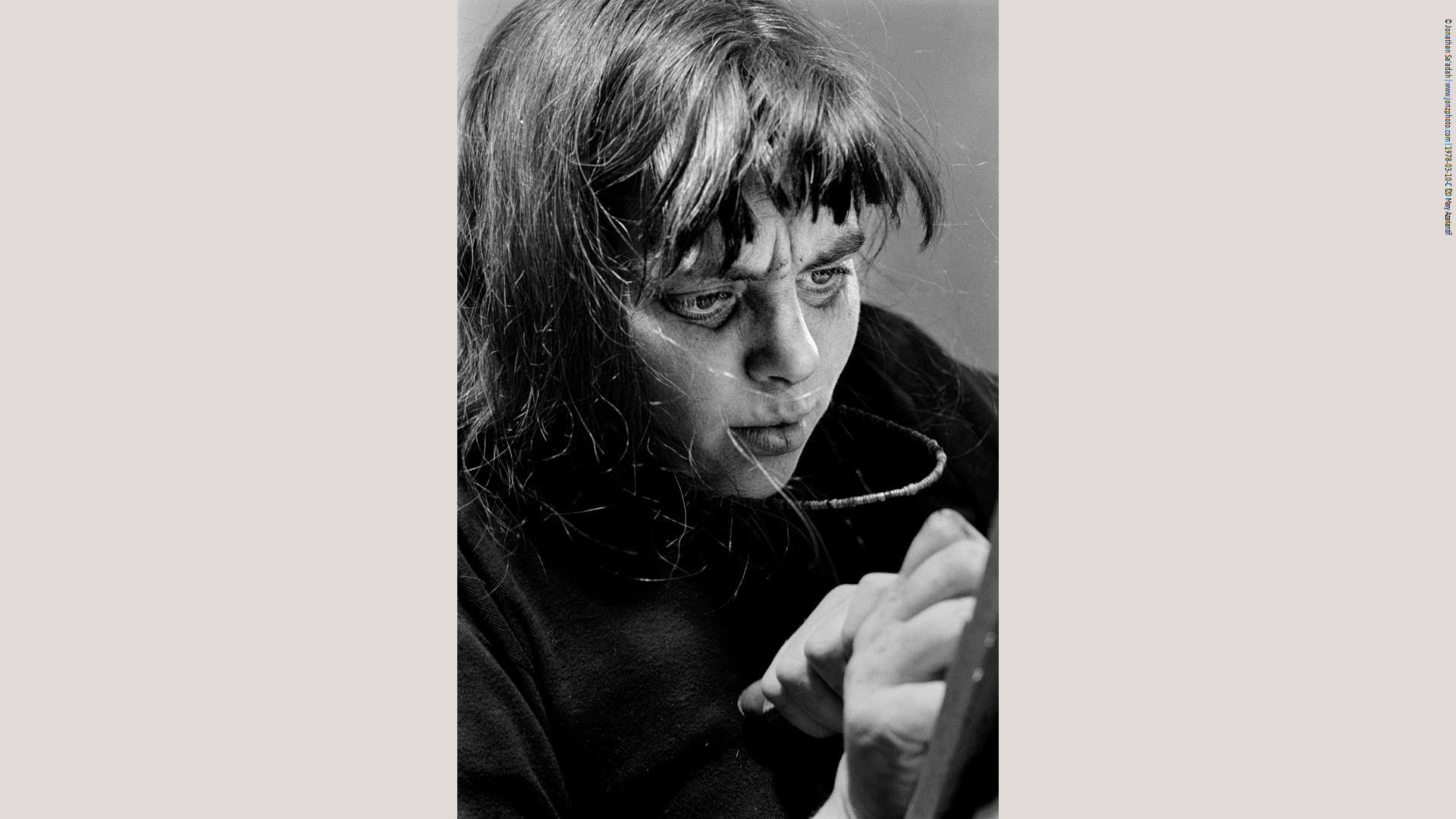
    Mary Azarian lived (and lives) on a family hilltop farm in Vermont. Her woodcuts are widely published and have won many awards. She also publishes books through the Farmhouse Press.

    What I witnessed, from studio to studio, was the tangible impact of unconditional support. These seven artists — selected by Segal with an advising committee — represented the kind of working creatives who sustained Vermont’s cultural life but rarely received institutional recognition or steady income. For them, Vermont Images was not a stepping stone or a credential-building opportunity. It was a lifeline. The support I helped administer allowed them to continue their work, to deepen their practice, and to remain in Vermont rather than perhaps migrating to larger cultural centers where opportunities for artists were more abundant.

    I learned something during that year that bureaucrats and institutional administrators often miss: the direct correlation between financial security and artistic flourishing. I saw how steady income removed the constant anxiety that forces artists to abandon their studios for survival jobs. I understood, from conversations and studio visits, how meaningful the program’s support had been in these artists’ lives.

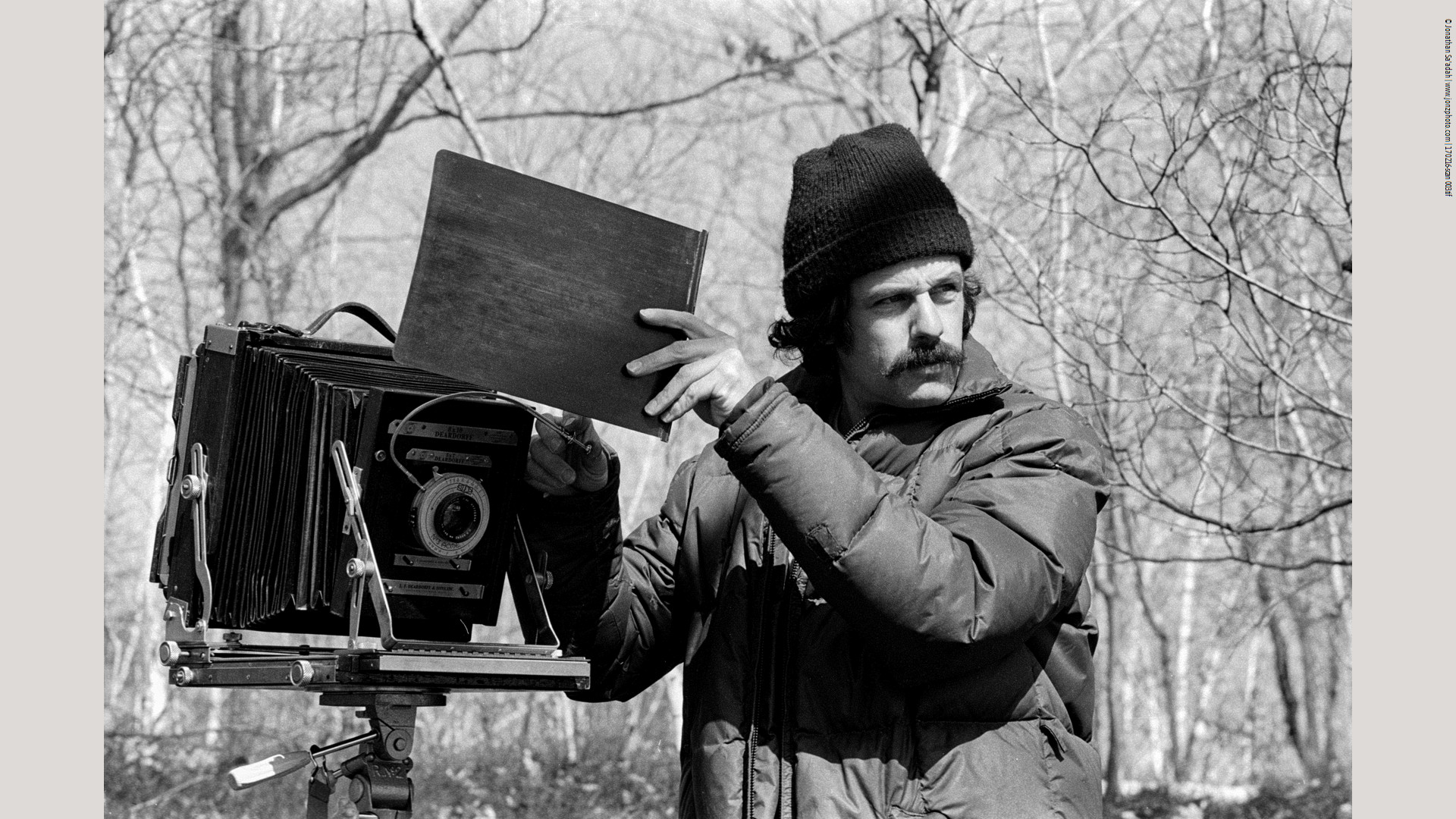
    Carlos Richardson used negatives taken with an 8×10 view camera in making platinum prints. He had a career as a teacher and a photographer.

    The Clash Between Vision and Institution

    But Vermont Images existed in tension with the institution that housed it. The Vermont Arts Council itself was run by Ellen McCulloch-Lovell, an establishment-oriented administrator more at home navigating institutional relations and political support than thorny artist questions. McCulloch-Lovell deserves credit for building up Vermont’s arts infrastructure and contributing substantially to the state’s cultural development. But her orientation was fundamentally different from Segal’s — and mine, by extension.

    Where McCulloch-Lovell thought in terms of institutions, infrastructure, and sustainability, Segal thought in terms of artists and creative need. Vermont Images represented that artist-centered philosophy taken to its logical conclusion: direct support, no strings attached, no institutional mediation.

    It was too free-form for the Vermont Arts Council. The program was not renewed.

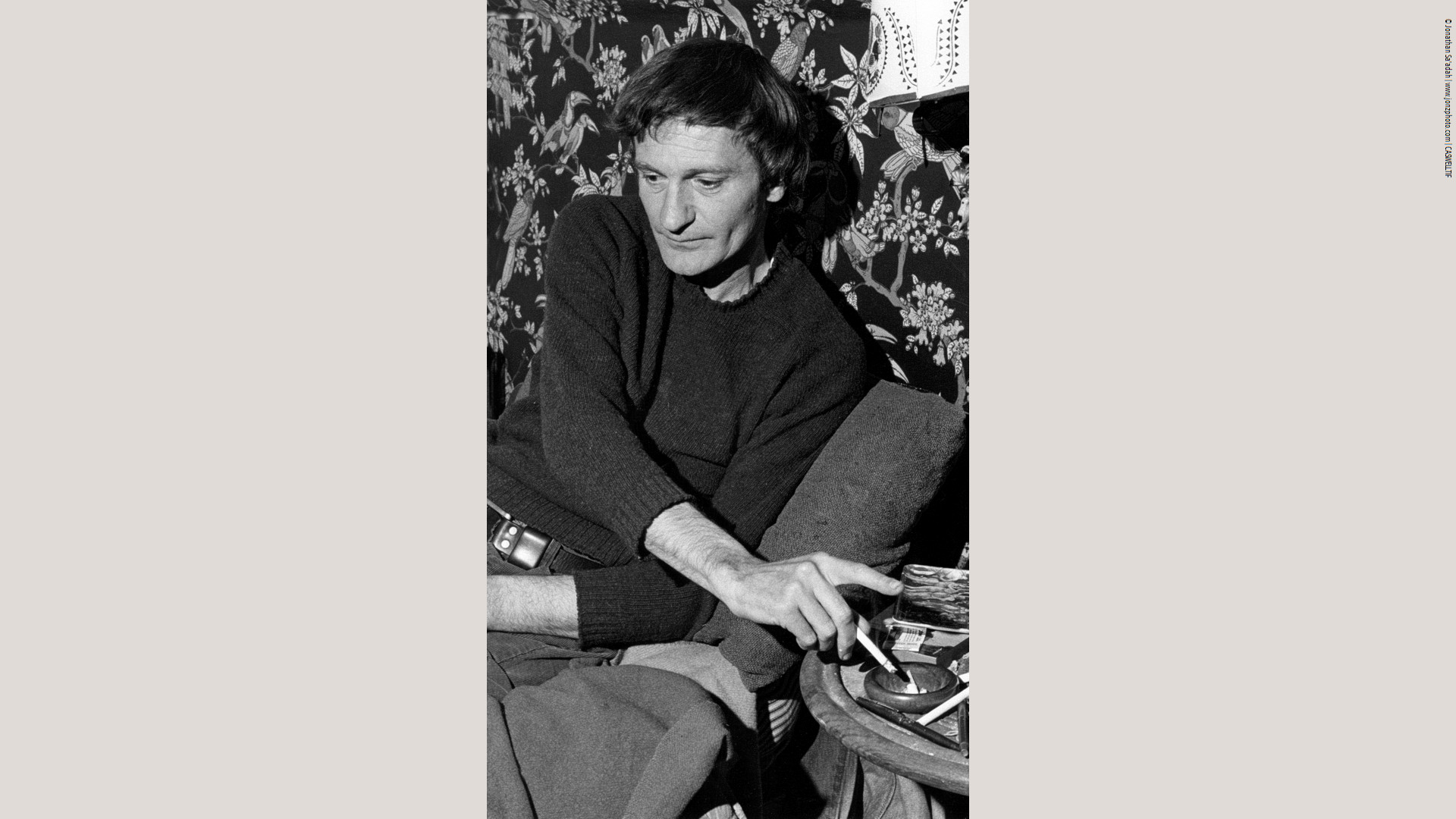
    Robert Caswell was a poet and professor in Burlington Vermont. He taught at the University of Vermont in the English department and is remembered for his book Exiled from North Street. He died in 2014.

    In any case, nationally the CETA program was winding down. When Ronald Reagan took office in 1981, he moved quickly to terminate CETA altogether, abruptly ending a decade of federal arts employment support. The remaining CETA programs in Vermont, which had continued to support artists working with cultural institutions, were shuttered. The experiment was over.

    A Glimpse of What Was Possible

    My year as administrator of Vermont Images offered a rare window into what federal arts support could look like when bureaucracy stepped back and trust stepped in. It had a modest budget and seven artists to support — not enough to transform the state’s cultural landscape, but enough to change the lives of those seven people, and myself. I had traversed Vermont’s back roads and witnessed creative practice in its most authentic form, unmediated by institutional necessity.

    The program lasted only a year. It never grew. It was deemed too unconventional to continue. But for those seven artists, and for me, it represented something exceedingly rare in American life: a government program designed not to serve the state’s interests, not to build institutions, not to create measurable outcomes — but simply to support artists in doing their work.

    That simplicity, that directness, that trust in creative practice itself — these things made Vermont Images worth remembering, even fifty years later.

    Ernestine Pannes was a cross-dispciplinary researcher and writer, and was always exceedingly hard to pigeonhole. The committee decided that her research as a sociologist met the test for artistic work and supported her project studying the Vermont town of Weston. Her work was published under the title Waters of the Lonely Way.
  • The Bittersweet Story of Syria’s Christians

    The first in a series introducing my new photo book “Return to Damascus: A Personal Journey.” This post is about my family’s long-term history in Syria and at least some of the story of how we ended up in America.

    “He saved us with a single act of mercy.”

    These words, spoken by my father, referred to Abd el-Qadir al-Jaza’iri’s heroic intervention in Damascus in 1860 – a moment that shaped my family’s destiny and countless others.

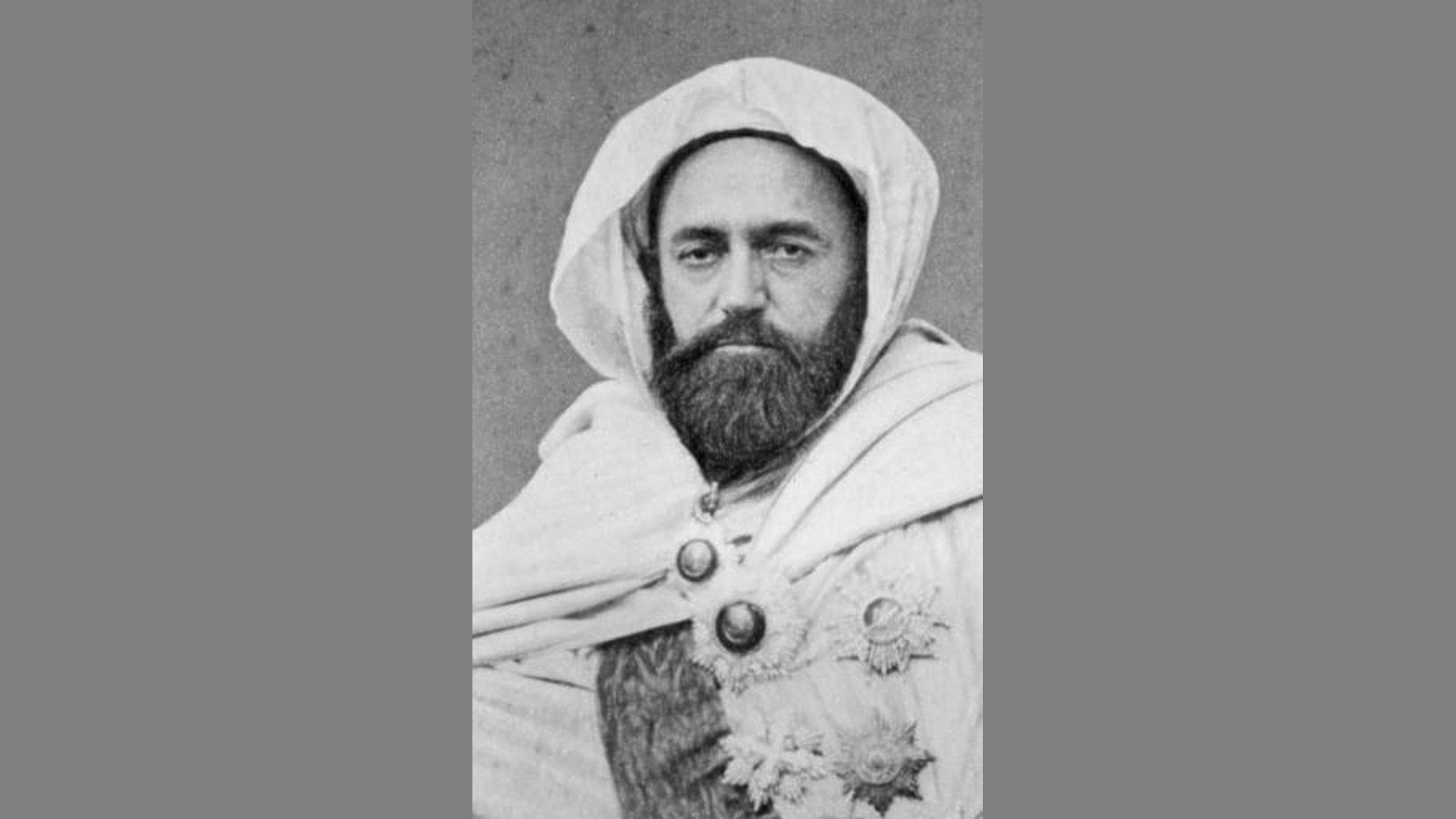
    Abd el-Qadir (1808-1883) was trained as a religious scholar but for 15 years (1832-1847) he led the Algerian resistance against French colonization. After his surrender in 1847 he was imprisoned in France for five years before being released by Napoleon III and moving to Damascus. He lived in the city as a respected figure with a retinue of Algerian followers, so he was uniquely positioned to intervene in the anti-Christian violence of 1860. (US Library of Congress)

    When I set out to understand my family’s roots, I discovered that the story of Levantine Christian migration is both a tale of lucky survival and and stubborn resilience. It stretches from the violence that erupted in Mount Lebanon and Damascus in 1860 to the streets of Montreal, Brooklyn, Detroit-Dearborne, Brazil, Argentina, and many other places today. Syrian Christians have forged new communities across the globe, carrying traditions, languages, and memories with them.

    The 1860 Watershed

    In the spring of 1860, centuries of relative coexistence between Christians and Muslims in the Ottoman Empire shattered. Economic tensions, administrative reforms, and armed conflicts in Mount Lebanon spilled into Damascus, where Druze militias and local mobs attacked Christian neighborhoods. Thousands were killed, and homes and churches were destroyed. It was a catastrophe that reverberated across the Mediterranean world.

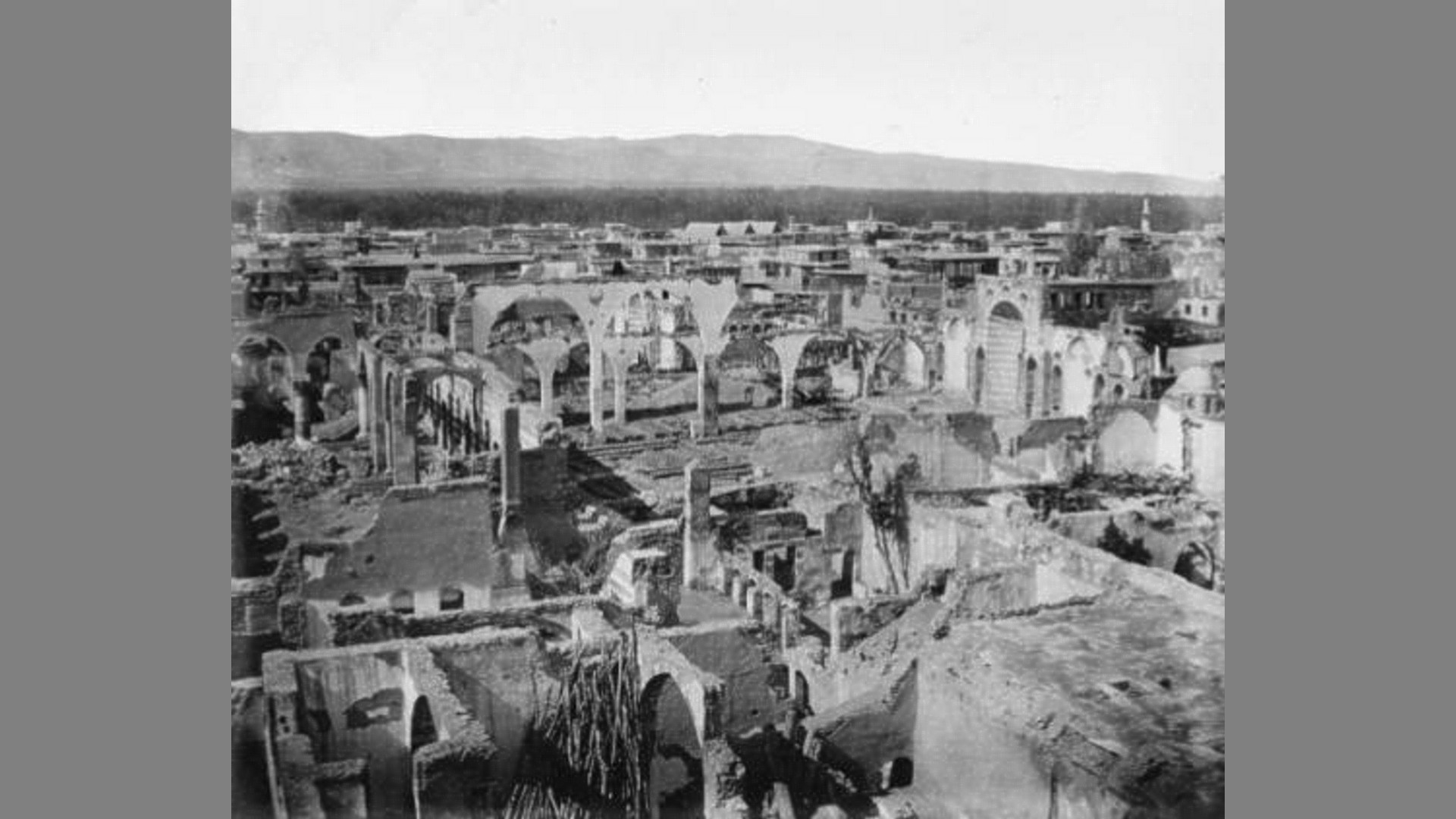
    The Christian quarter of the Old City in Damascus after the 1860 violence In spite of Abd el-Qadir’s intervention an estimated 2,500 Christians died in Damascus alone, with 1,500 homes burned and 270 houses destroyed by looters. (US Library of Congress)

    Amid the chaos, one leader stood out: the Algerian-born Emir Abd el-Qadir. Living nearby, he intervened to protect Christian refugees – placing his family and followers between the mobs and Christians and personally leading women and children to safety.

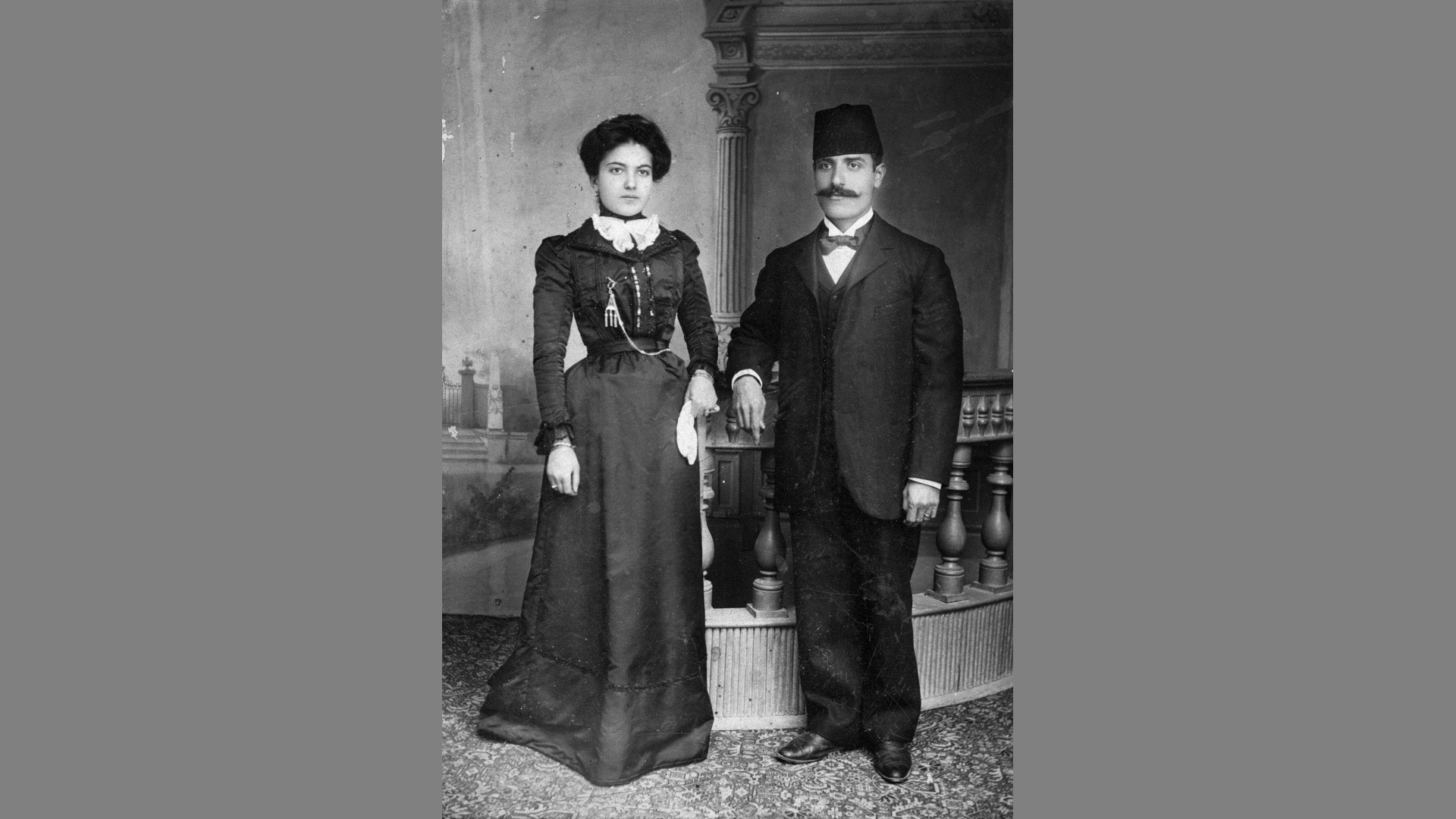
    My paternal grandparent’s wedding photo My grandfather is wearing a fez because under Ottoman rule Arab Christians were required to show subservience. My grandmother was not born in Damascus but came from the nearby Christian village of Yabrud.

    This 1860 violence triggered the first large wave of Christian emigration. Families, traumatized by the massacres and fearful of a repeat, turned their eyes westward.

    Pioneers to Canada

    The earliest Levantine Christian settlers in Canada arrived in New Brunswick in 1879. Unlike the later urban enclaves in Montreal and Toronto, these pioneers ventured into small towns – opening general stores and peddling goods across rural routes. They etched their names into local histories as hardworking merchants who bridged cultural divides. Many never expected to settle permanently. They did though, building homes, marrying local partners, and raising children who knew their Syrian history only through photographs and stories passed down at the dinner table.

    America’s Mass Migration

    Simultaneously, a much larger exodus was underway to the United States. Steamship companies marketed opportunities in Philadelphia, Chicago, and New York – highlighting factories hungry for labor and the potential for a better life. Between 1860 and 1914, nearly half of Mount Lebanon’s Christian population emigrated, with Syrians joining the ranks of what was referred to at the time as “the new Americans.”

    In Philadelphia, Syrian entrepreneurs opened fruit stands and textile shops. In Chicago, they staffed steel mills during the city’s rapid expansion. My father, who left Damascus in the 1920s for Beirut and later America, found work in a Vermont school teaching Arabic and in a couple of nearby churches as an Universalist minister. Like many, he sent letters back home – describing snowdrifts blocking roads and the smell of pine forests in ways that made our family’s memories of olive orchards and souks feel like distant dreams.

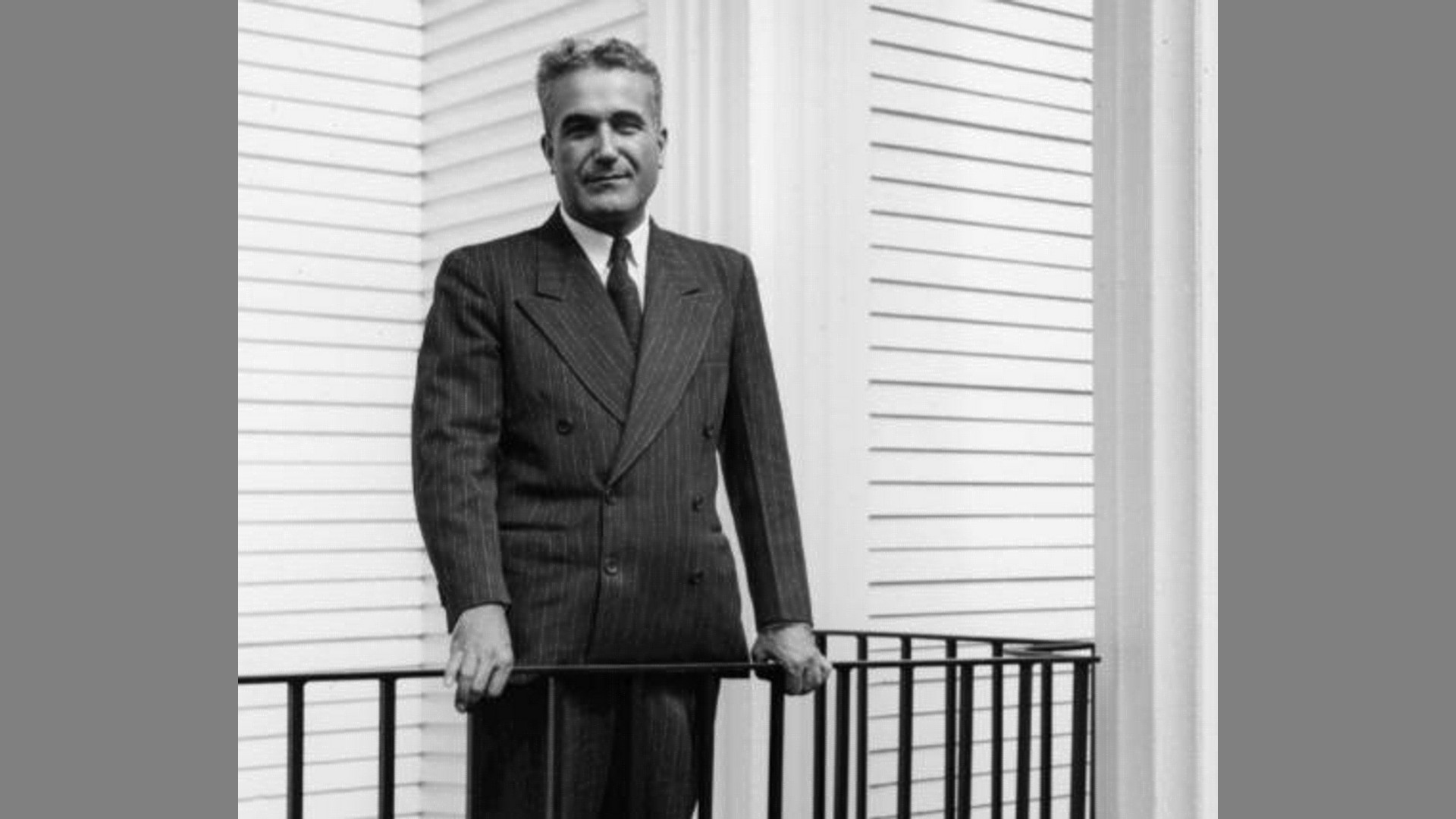
    Mounir Sa’adah, my father, on the porch of the Universalist Church in Woodstock, Vermont, where he served as minister from 1946-1964. (Ken Miner, Photographer)

    A Special Bond with France

    Across the Atlantic, France held a unique allure for Levantine Christians. The French “Protectorate” over Lebanon and Syria (1920-1946) created educational, linguistic, and administrative ties, making Paris a natural destination for students and professionals. Catholic missions in Beirut and Aleppo funneled promising young Christians into French universities, where they studied law, medicine, and literature.

    After graduation, some returned home; others remained in France, blending into Parisian neighborhoods. Their emigration differed from North America’s because they often enjoyed closer political ties and shared religious networks – and yet, they encountered challenges of assimilation and identity that echoed those of their North American counterparts.

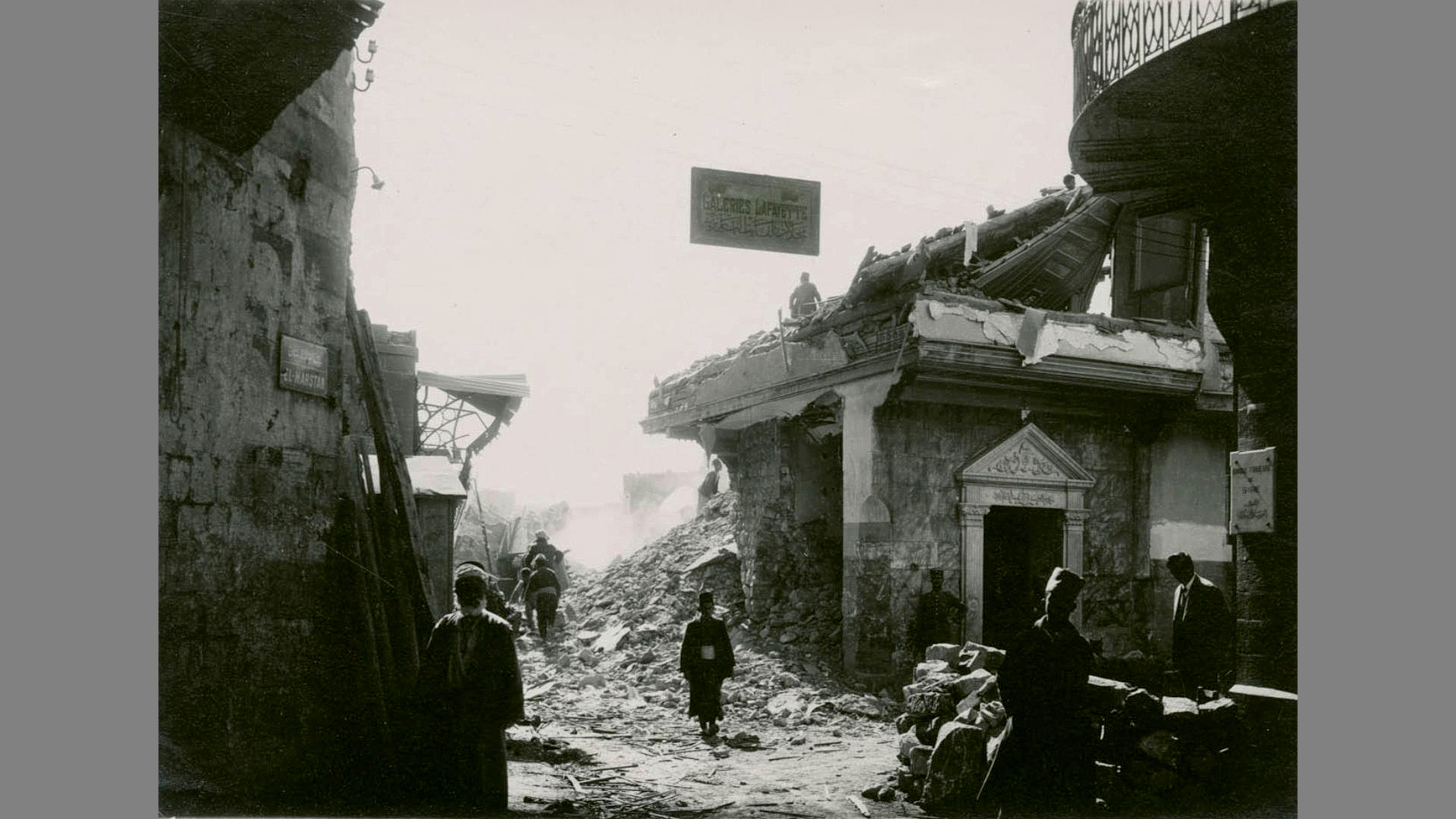
    Syria’s complicated history with France In the text I put “Protectorate” in quotes because the reality is that France forcibly prevented Syrians from forming their own independent nation. These are buildings bombed by the French in 1920, at the same time the roof of the main souk was shot up. (US Library of Congress)

    Economic and Social Drivers

    These early migrants were motivated by more than fear. Steamship agents sold tales of golden opportunities, churches organized sponsorships, and community letters home detailed business successes. Young men also sought to avoid Ottoman military conscription, which often meant years of service under harsh conditions.

    This “emigration fever” spread quickly. Prosperity stories – of peddlers returning with wagons full of cash – encouraged others to risk the voyage. Similar stories were repeated by migrants to Mexico and South America. Families pooled savings to buy single tickets, hoping to reunite later. Missionaries and diaspora societies provided lodgings, language lessons, and job placement assistance.

    Preserving Culture in the Diaspora

    Diaspora communities across Canada, the United States, and France worked hard to preserve their culture. Churches taught Arabic and Aramaic liturgies; social clubs hosted dance nights; local grocers sold za’atar and ma’amoul; newspapers in Arabic bridged generations. Families celebrated Christmas with mezze spreads, blending Levantine recipes with North American traditions.

    Through these practices, they maintained a strong sense of identity – one that connected them to the villages of Mount Lebanon, the courtyards of Damascus, and the stone village of Ma’lula. Yet, each new homeland shaped them in turn, creating unique hybrid cultures that were neither fully Syrian nor completely Western.

    Weaving Family and Diaspora

    My own family’s journey followed these patterns. My paternal grandparents remained in Damascus where my father was born in 1909, later attending the American University in Beirut. In 1946, he and my mother traveled to Vermont. After departing the Middle East, he never returned for any extended period, yet It remained a strong part of him.

    My mother, who was not Syrian but Armenian, had three children with my father, of which I was in the middle. The book “Return to Damascus” is loosely about my father’s own pilgrimage to Damascus in 2000 when he was ninety years old and where he retraced his arc: from the United States back to the streets he had grown up on.

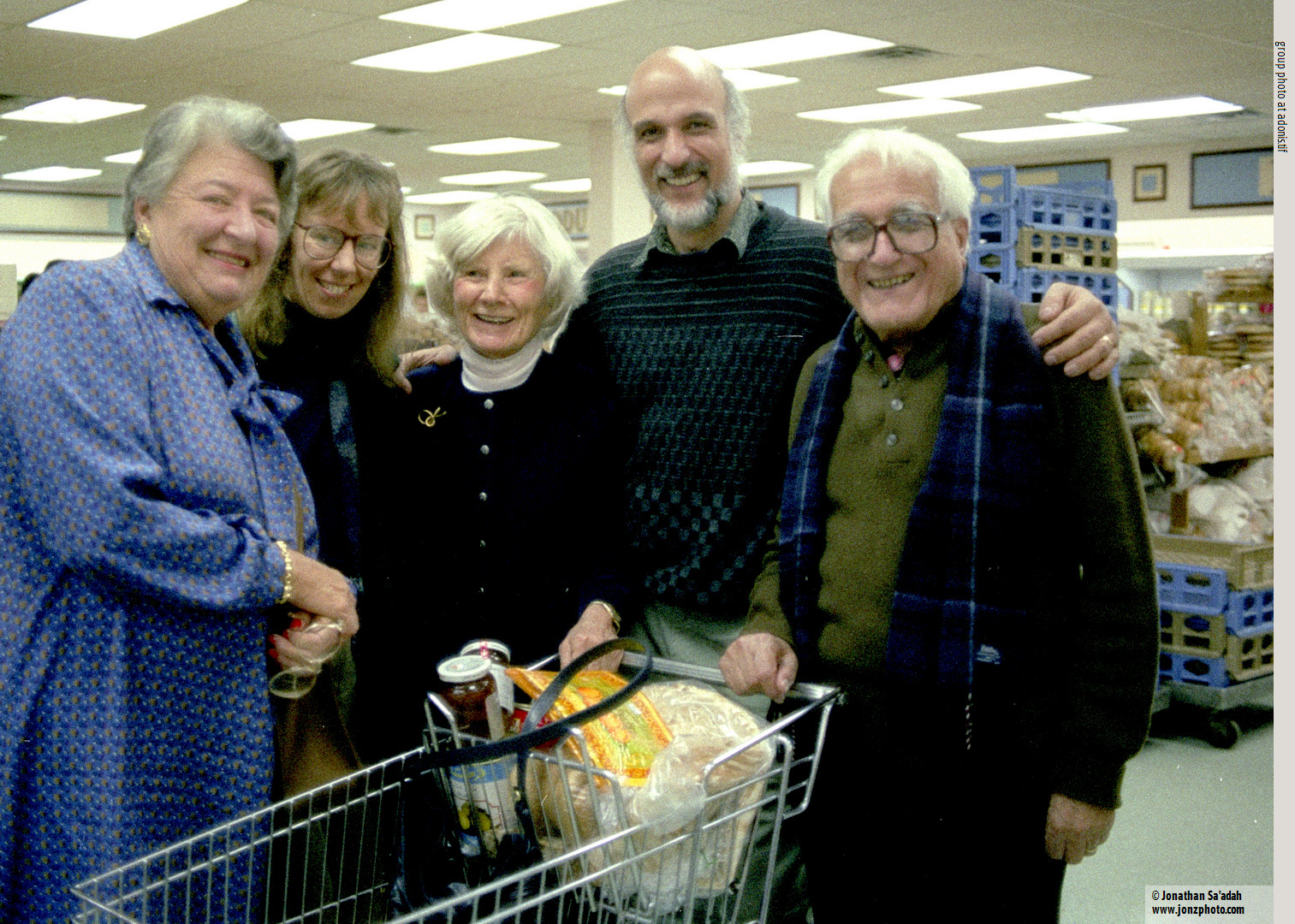
    Early 1990s family trip to Montreal to purchase Syrian groceries We drove up from Vermont on a day trip to shop in a small Syrian grocery store. I have my arms around my parents and the woman on the left (next to my wife, Beth) is Abbe Sawabini, who married into a Palestinian family and lived in Burlington, Vermont.

    Setting the Stage for Cultural Preservation

    History plays an important role in my photography book. The images of Ma’lula, the candid portraits along with the streets and places of Damascus, carry deeper meaning for me because of the family diaspora story. But our stories are by no means unique. My family’s history reminds me that many family photo albums hold stories of departure and return, of belonging and loss. But for me the journey from Damascus to Montreal is not just geographical – it is a testament to the enduring spirit of Levantine Christians who carried their heritage across oceans and generations.


    “Return to Damascus: A Personal Journey” can be pre-ordered from Phoenicia Publishing at a discount for delivery in November.

  • Moki Cherry: Swedish Artist and Designer

    I met Moki Cherry in 1969 when she and Don were living in Vermont. Jon Appleton, a professor in the Music Department of Dartmouth College, had invited Don and Moki to come to the United States and teach a course for the spring term.
    Later, I went to Sweden where I spent part a summer living with the family in Stockholm during the Utopias & Visions 1871-1981 exhibit at the Moderna Museet and traveling to Tågarp just after they had purchased the schoolhouse. These pictures are from that period.

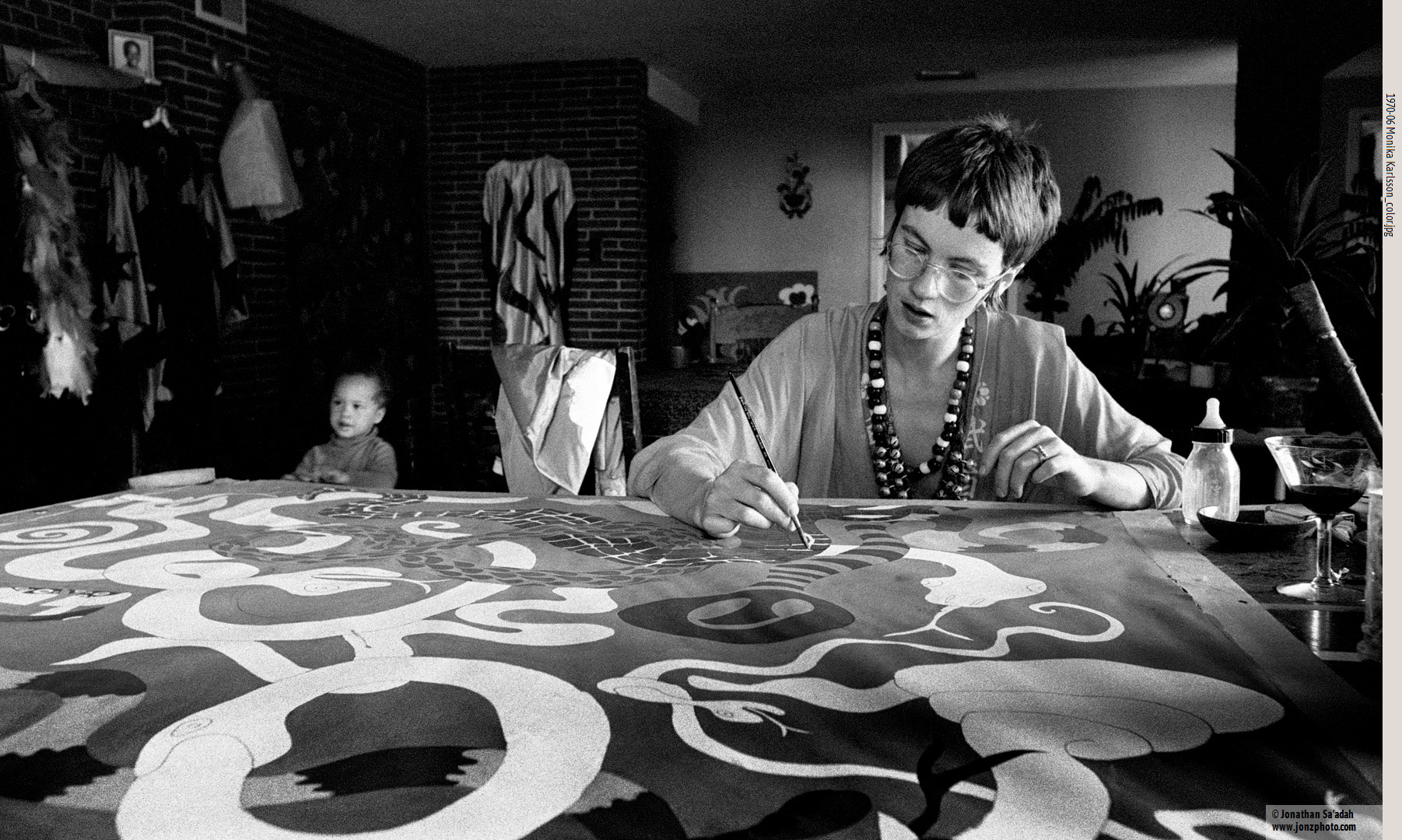
    A delicate balance Moki Karlsson surrounded by her work and family in her Post Mills, Vermont home. Every detail of this photograph represents Moki – her son Eagle-Eye, Don’s performance costumes hanging on the wall, the plants…Moki created worlds where she lived, centered around her family and her projects. (Vermont, 1970)

    Early Life and Education

    Monika Marianne Karlsson was born on February 8, 1943, in Koler, a small town in Norrbotten, Sweden’s far northern region. Her parents, Verner Karlsson and Marianne Karlsson, were from opposite ends of Sweden – her father was from Skåne in the south and her mother from Norrland in the north. Verner worked as a station master for the railway company, while Marianne ran the local post office. The family moved frequently throughout Sweden as Verner was posted to different stations.

    From an early age, Moki displayed an independent spirit and a deep connection to nature. She was absorbed by the world of animals and the natural environment, preferring to spend time in the forest rather than with other children.

    After leaving school in 1959, Moki apprenticed at the Haute Couture Atelier Anna-Greta Blom before working as a design assistant with Vera Öhrn at Distingo, a women’s coat and suit manufacturer in Kristianstad. In 1962, she moved to Stockholm to study fashion design, illustration, and pattern-cutting at Beckman’s School of Design (now Beckmans College of Design).

    Meeting Don Cherry and Early Artistic Collaboration

    In 1963, while still a student, Moki met American jazz trumpeter Don Cherry at Gyllene Cirkeln (The Golden Circle) in Stockholm, where he was performing with saxophonist Sonny Rollins. Don was already recognized as one of the leading figures in American avant-garde jazz, having been a key member an innovative quartet that shook up American jazz in 1959 (The Ornette Coleman Quartet).

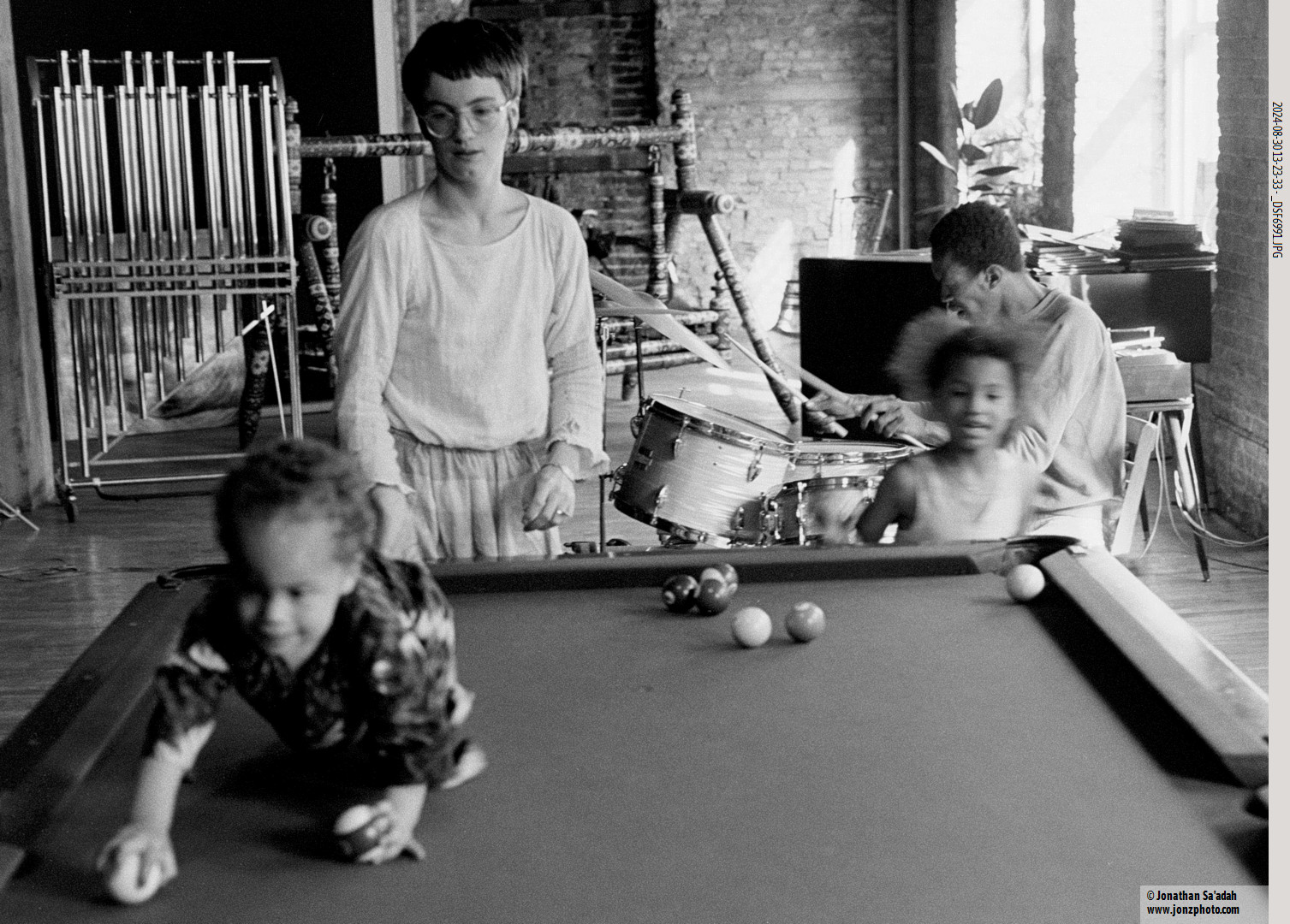
    Often multi-tasking Eagle-Eye has a clear idea of where he wants to pocket the shot (with Neneh’s encouragement). Don is practicing drums while waiting for Ornette Coleman to show up in Coleman’s Prince Street loft. (New York, 1970)

    Artistic Practice and Philosophy

    Moki’s artistic practice was inherently interdisciplinary, encompassing textiles, painting, sculpture, ceramics, collage, set design, and costume creation. Her work was characterized by bold colors, organic forms, hybrid creatures, and spiritual symbolism drawn from various cultural traditions including Indian art, Tibetan Buddhism, African aesthetics, and Scandinavian folk art.

    Textiles and Tapestries

    Moki’s textile work became her signature medium, born out of practical necessity. Living a nomadic lifestyle with Don and her family, she found that fabric was lightweight, transportable, and versatile. She could “roll it up, put it in a couple of duffel bags” and carry her studio anywhere. Her large-scale textile appliqué tapestries served multiple functions: as stage backdrops for Don’s performances, album covers, as educational tools for children’s workshops, and as independent artworks displayed in galleries.

    Major Exhibitions and Recognition

    Moderna Museet Stockholm (1971)

    One of Moki’s most significant early exhibitions was at Moderna Museet Stockholm in 1971, as part of the Utopias & Visions 1871-1981 exhibition. Pontus Hultén, the museum’s director, commissioned Don and Moki to create an installation which was housed in a Buckminster Fuller geodesic dome. Moki created artwork which defined the performance space, which was used to gather artists and musicians from Europe and beyond.

    From 1977 onward, Moki split her time between Tågarp (the family home near Malmö) and Long Island City, New York, maintaining her connection to both her Swedish roots and the international art community. She continued to exhibit regularly, with solo shows in galleries across Sweden, the United States, and Europe.

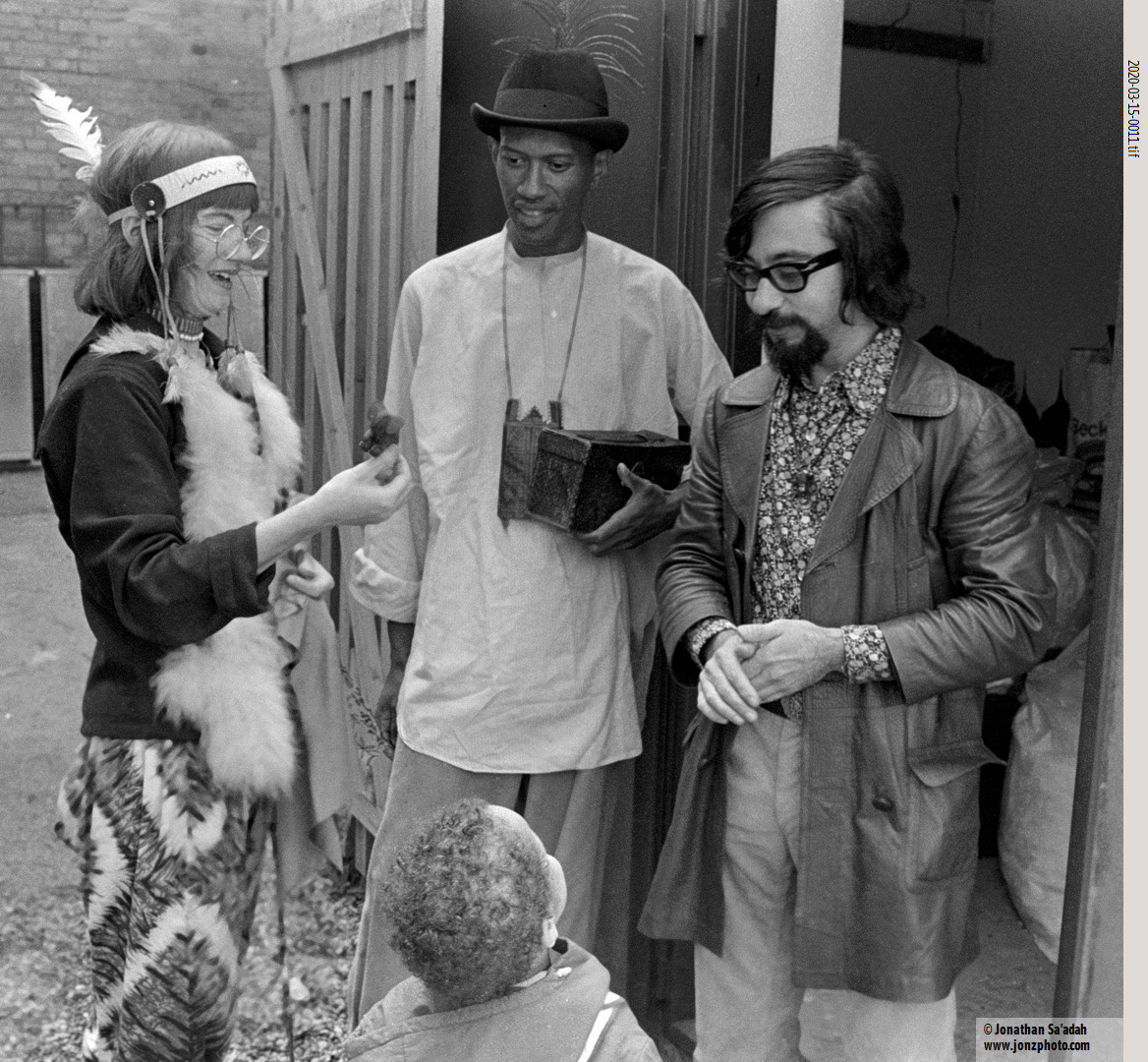
    Collaborators in Stockholm Don Cherry is holding the leather case, home to his pocket trumpet, while the Turkish percussionist Okay Temiz talks to Eagle-Eye. They are standing immediately outside the naval brig on the Stockholm island of Skeppsholmen that was used as housing for the family during the 1970 summer exposition. (Stockholm, 1971)

    Personal Life and Family

    Moki’s personal life was inextricably linked to her artistic practice. Moki successfully balanced motherhood, artistic practice, and professional collaboration. She said about the challenges: “I was my husband’s muse, companion and collaborator. At the same time, I did all the practical maintenance. I was never trained to be a female, so I survived by taking a creative attitude to daily life and chores.”

    Legacy and Rediscovery

    Moki Cherry died on August 29, 2009, in her Tågarp home. For much of her lifetime, her contributions were overshadowed by Don’s fame and the gendered biases of the art world toward textile work. However, the period following her death has seen a resurgence of interest in her work.

    Major retrospectives include Moki Cherry: A Journey Eternal at Moderna Museet Malmö (2023), the most comprehensive presentation of her work to date, and Moki Cherry: Here and Now at the Institute of Contemporary Arts, London (2023), her first solo exhibition in a UK institution.

    These exhibitions have been curated in collaboration with her granddaughter Naima Karlsson, who has become a key advocate for her grandmother’s legacy.

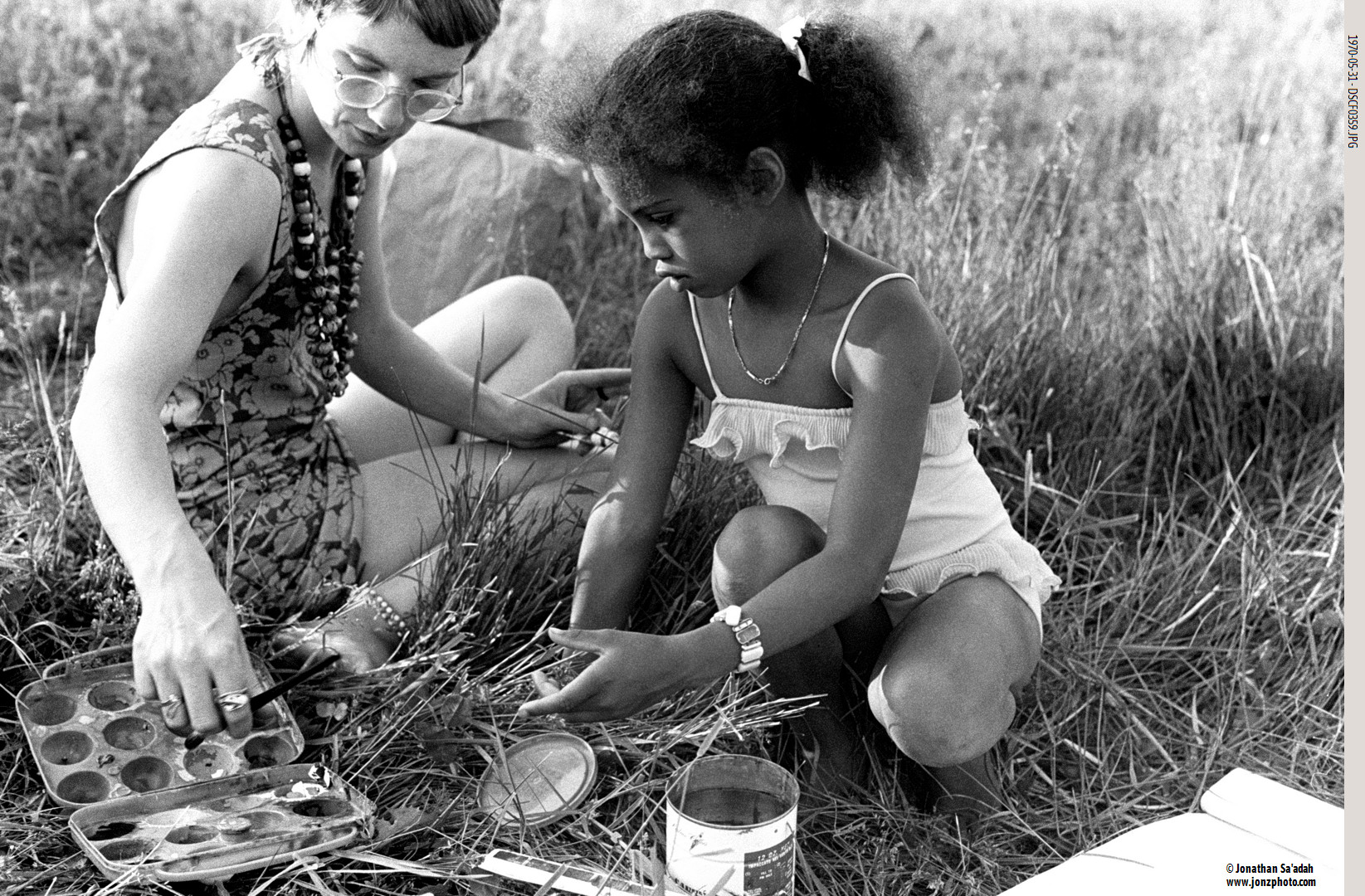
    Moki helping Neneh with color Neneh was a voracious daughter to Moki’s sensibilities which she combined with her step-father’s musical world. Both have served her well. (Vermont, 1970)

    Writing and other media about Moki’s work and life

    Moki’s work abounded in color. These articles and web pages have reproductions which often do justice to her chromatic sensibilities.

    Adesina, Precious. “Moki Cherry: The Overlooked Swedish Artist Who Created a ‘Soulful Home,’” January 1, 2024. https://www.bbc.com/culture/article/20231222-moki-cherry-the-overlooked-swedish-artist-who-created-a-soulful-home.
    Carsel, Casey. “Moki Cherry’s Art and Life Remembered,” September 29, 2021. https://ocula.com/magazine/spotlights/moki-cherrys-art-and-life-remembered/.
    Compton, Gemma. “Moki Cherry – Here and Now. – Blog.” Gemma Compton, February 6, 2024. https://www.gemmacompton.com/blog/2024/2/6/moki-cherry-here-and-now.
    Denman, Tom. “Moki Cherry at the Juncture of Art and Life.” ArtReview, August 22, 2023. https://artreview.com/moki-cherry-at-the-juncture-of-art-and-life/.
    “Don and Moki Cherry’s Organic Dreams Made Real.” National Public Radio, June 18, 2021. https://www.npr.org/2021/06/18/1007252382/don-cherry-and-moki-cherry-organic-music-society.
    “Don Cherry — Brown Rice (LP, Brown Vinyl) — Soundohm.” https://www.soundohm.com/product/brown-rice-lp-brown-vinyl.
    E-flux. “Don and Moki Cherry: Organic Music Societies, Alexander Kluge: Minutenfilme #3 – Announcements,” February 8, 2022. https://www.e-flux.com/announcements/438577/don-and-moki-cherryorganic-music-societiesalexander-kluge-minutenfilme-3.
    E-flux. “Moki Cherry: A Journey Eternal – Announcements.” https://www.e-flux.com/announcements/557927/moki-cherrya-journey-eternal.
    Krasinkski, Jennifer. “Krasinski_Artforum_Cherry.” ArtForum, June 1, 2021. https://www.blankforms.org/sites/default/files/2022-07/Krasinski_Artforum_Cherry.pdf.
    Larsen, Lars Bang. “Moki Cherry Exhibit at Galleri Nicolia Wallner, Copenhagen.” Nicolai Wallner (blog), April 7, 2022. https://nicolaiwallner.com/exhibition/moki-cherry-2/.
    Moderna Museet I Malmö. “A Journey Eternal.” https://www.modernamuseet.se/malmo/en/exhibitions/moki-cherry/a-journey-eternal/.
    Moderna Museet I Malmö. “From Norrbotten to New York.” https://www.modernamuseet.se/malmo/en/exhibitions/moki-cherry/from-norrbotten-to-new-york/.
    Mokicherry.com. “About Moki Cherry.” https://mokicherry.com/about.
    Mokicherry.com. “Moki Cherry Exhibitions.” https://mokicherry.com/exhibitions.
    Neneh Cherry, Naima Karlsson + More on Moki Cherry’s Life, Love and Work as an Artist and Mother | ICA Infrequencies, 2023. https://shows.acast.com/ica-infrequencies/episodes/moki-cherry-home-as-stage-stage-as-home.
    NOBA Nordic Baltic Contemporary Art Platform. “Moki Cherry Exhibit in Malmö.” https://noba.ac/en/exhibition/moki-cherry.
    Psimikakis-Chalkokondylis, Laonikos. “Imagine! Play! Learn! – By Evie Ward.” Sound and Music (blog), August 31, 2022. https://soundandmusic.org/post/imagine-play-learn-by-evie-ward/.
    Reeves, Chris. “A Praxis of Art and Life: A Review of Moki Cherry at Corbett vs. Dempsey | Newcity Art a Praxis of Art and Life: A Review of Moki Cherry at Corbett vs. Dempsey,” September 15, 2021. https://art.newcity.com/2021/09/15/a-praxis-of-art-and-life-a-review-of-moki-cherry-at-corbett-vs-dempsey/.
    Russonello, Giovanni. “A Fresh Look at the ‘Organic Music’ of Moki and Don Cherry..” Jordan News, April 30, 2021. https://www.jordannews.jo/Section-117/Culture-Arts/A-fresh-look-at-the-organic-music-of-Moki-and-Don-cherry-2283.
    Snoekx, Kurt. “Home Is Where the (He)Art Is: Argos Revisits Don & Moki Cherry’s Organic Music Society,” December 2, 2022. https://www.bruzz.be/en/culture/art-books/home-where-heart-argos-revisits-don-moki-cherrys-organic-music-society-2022-02-11.
    Tolhurst, Sophie. “Rediscovering Swedish Designer and Artist Moki Cherry.” Design Week, June 9, 2023. https://www.designweek.co.uk/issues/05-june-09-june-2023/swedish-designer-artist-moki-cherry/.
    Walton, Millie. “Burlington Contemporary – Reviews,” August 23, 2023. https://contemporary.burlington.org.uk/reviews/reviews/moki-cherry-here-and-now.
    Ward, Evie. “Mobile Aesthetic Environments.” Moderna Museet I Malmö. https://www.modernamuseet.se/malmo/en/exhibitions/moki-cherry/mobile-aesthetic-environments/.

  • Minor White

    South Pomfret, Vermont, 1970
    South Pomfret, Vermont, 1970

    From Fall, 1970 through the following June I was a student of Minor White’s. Though I was chronologically an undergraduate he placed me in his graduate program. It’s people from that class that you see in the circle above.

    If history is written by victors it also contains a good measure of current social mores. I was pleased to be sent a link to this recent essay by Susan Stamberg. White died almost thirty years ago. The essay has candor and judgement in its measurement of the man, who I knew only in the context of school and a few extended workshops. But I think there is a poignancy in this photo that’s correct.

    I’m also attached to the photo for a personal reason. If you look closely there is a hill hiding in the background fog. It is a small ski area in Vermont called “Suicide-Six”, which was the local ski hill when I was young. So seeing it always makes me smile.